
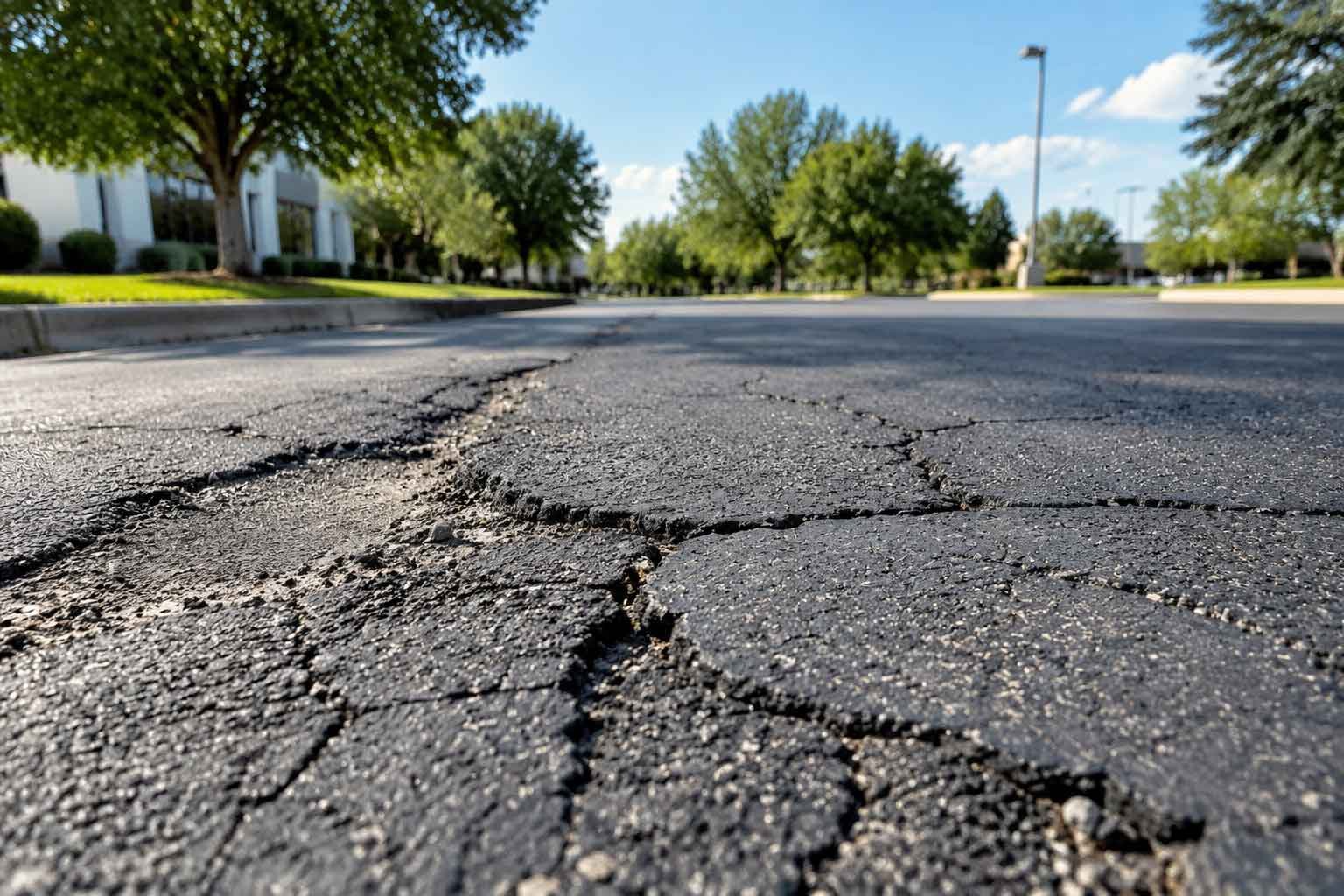
Asphalt rarely fails overnight. What looks like a sudden pothole or a long crack is usually the result of smaller problems that have been developing beneath the surface for months or years. Asphalt deteriorates because four forces act on it at the same time: UV oxidation, water intrusion, thermal cycling, and traffic loads.
In Southern California, the sun does the damage that ice does in colder states. It hardens the asphalt binder, opens the surface, and gives water a way in. Traffic loads then press down on pavement that UV and water have already weakened.
Poor drainage, a weak aggregate base, installation shortcuts, chemical exposure, age, and deferred maintenance accelerate the process, and these factors almost always work together.
Empire Parking Lot Services has handled asphalt repair in Orange County since 2008, and the right repair depends on which of these forces has done the most work.
How Asphalt Deteriorates Over Time
Stage 1: The Surface Begins to Age
UV exposure and oxidation harden the asphalt binder and strip out its flexibility. The surface fades to gray, but the lot still looks sound at this stage.
Stage 2: Cracks Develop
A brittle surface cannot absorb movement. Traffic, daily temperature swings, and shifting soil open hairline cracks that widen with each season.
Stage 3: Water Gets In
Cracks and weak joints give water a direct route through the surface layer, where it separates the binder film and the stone it coats. Loose stone then shifts under every passing tire.
Stage 4: The Base Weakens
Asphalt is not a single layer of black material sitting on the ground. It is a surface course over a compacted aggregate base and a prepared subgrade, and that structure carries the load. Water that reaches the aggregate base washes out the fine material, softens the subgrade, and takes away the support the surface was built on.
Stage 5: Structural Damage Appears
The damage that finally gets reported is the last step: potholes, alligator cracking, rutting, depressions, settlement, and crumbling edges. Each visible symptom traces back to a cause that began years earlier, and the repair must address that cause.
What Causes Asphalt to Crumble?
Asphalt crumbles when the binder that glues the stone aggregate together loses its flexibility. A new binder bends slightly under weight and springs back. Over time, it stiffens, and a stiff binder cannot hold the aggregate in place under repeated loads.
The binder fails in a specific order:
-
UV oxidation dries the binder and makes it brittle
-
Thermal cycling expands and contracts the brittle surface until it cracks
-
Water intrusion enters those cracks and washes out the aggregate base below
-
Traffic load presses down on a base that can no longer support it
A lot that shows raveling in a drive aisle usually has all four factors active at once, which is why preventing costly asphalt damage starts with stopping UV oxidation, the first link in the chain.
How Does UV Damage Asphalt?
Ultraviolet light breaks the chemical bonds in the asphalt binder, a process called oxidation. As the lighter oils evaporate, the surface turns gray, then sheds the fine material between the larger stones.
Orange County averages roughly 278 sunny days a year, compared with a national average of 205, so pavement here spends far more of its life under direct UV exposure.
Heat compounds the problem through thermal cycling. Asphalt reaches surface temperatures well above the air temperature on a summer afternoon, then cools sharply after dark, especially near the coast.
That daily expansion and contraction produces the short, spaced cracks known as block cracking.
Oxidation shows up before any crack does. Watch for these early signs:
-
Color shift toward light gray across the full lot, not just in traffic lanes
-
Fine surface texture that feels rough or sandy underfoot
-
Hairline cracks in a grid pattern on areas that receive no traffic
Sealcoating interrupts this cycle by forming a protective layer that absorbs UV radiation before it reaches the binder. Empire Parking Lot Services recommends asphalt sealcoating every 3 to 5 years, and full-sun lots with no shade tend toward the earlier end of that window. A sealed surface stays black and flexible, and a flexible surface delays the cracking that lets water in.
How Does Water Damage a Parking Lot?
Water damages a parking lot by stripping the binder off the aggregate and softening the base beneath. A wet base loses the density that gave it strength, and the surface above it flexes, cracks, and breaks apart.
Southern California receives about 14 inches of rain a year, concentrated into roughly 35 days. That pattern is harder on pavement than steady rainfall: a lot stays dry for eight months, develops open cracks, then takes a full season of runoff in a few weeks.
Water finds its way in through:
-
Unsealed cracks wider than a quarter inch
-
Joints where asphalt meets concrete curbs, gutters, or drain inlets
-
Settled areas that hold standing water for more than 24 hours
The progression ends in a pothole. On almost every lot in Orange County, the sequence that turns deterioration into potholes is the same: a crack forms, water enters, the base fails, and the surface caves in. Keeping water out of the base is the single most effective way to slow asphalt deterioration.
What Shortens a Parking Lot's Lifespan?
A commercial lot in Southern California should reach 20 to 25 years before full removal and replacement.
Traffic Loads Beyond the Design Spec
Most lots are built for passenger vehicles, so when delivery trucks, refuse haulers, and moving vans use the same drive aisles daily, the pavement carries loads it was never designed for.
Rutting in wheel paths, depressions at loading docks, and cracking where trucks turn all signal loads beyond the pavement section. Distribution facilities and retail centers with rear delivery lanes see this the fastest.
Petroleum and Chemical Exposure
Motor oil, gasoline, hydraulic fluid, and transmission fluid dissolve the same binder that holds the pavement together. A daily drip in the same stall softens the asphalt until the surface can be scraped away with a boot.
Tree Roots and Vegetation Pressure
Mature landscaping is common at Orange County commercial properties, and parkway tree roots push upward under nearby asphalt. Heaving along planter islands and lifted edges near curbs point to root pressure. Smaller vegetation also causes damage, since weeds that sprout in a crack widen it with each season of growth.
Weak Aggregate Base and Subgrade
Pavement is only as strong as what sits beneath it. Inadequate compaction, a base layer thinner than the traffic requires, or expansive clay in the subgrade all lead to early failure. Inland areas of Riverside and San Bernardino counties often sit on clay soils that swell when wet and shrink when dry, which can crack the pavement above no matter how well the surface was installed.
Deferred Crack Sealing
A crack sealed within its first season stays a crack. A crack left open through two or three winters becomes a base failure. Crack sealing is the lowest-effort intervention on this list and the one most often postponed, because a quarter-inch crack looks harmless until the surrounding section starts to move.
Skipped Maintenance Inspections
Property managers who walk their lots twice a year catch oxidation, ponding, and cracking while they are still surface issues. Those who wait for a tenant complaint find only base failures, because by the time a tenant reports a pothole, water has been in the aggregate base for months and the surface has lost its support. A structured parking lot maintenance schedule that pairs inspection with timely sealcoating and crack repair is the difference between a 25-year lot and one replaced at year 12.
Schedule a Site Assessment for Asphalt Repair in Orange County
Every Empire Parking Lot Services project begins with a Survey, the first step in the Four S process (Survey, Surface Prep, Safety, Speed).
A pre-production site walk brings together the customer, the estimator, and the production manager so the repair plan reflects the actual causes of deterioration on your lot rather than a generic scope.
Before each phase, you receive a "where, when, and how long" communication so tenants and staff know what to expect. Experienced foremen oversee the work, and you receive end-of-project photos and videos.
Empire Parking Lot Services has served Orange, Los Angeles, Riverside, and San Bernardino counties since 2008 under CSLB License #1098884. Request a free estimate for asphalt repair in Orange County or call 877.760.2757 to schedule a site assessment.
FAQs
What is the biggest enemy of asphalt?
Water causes the most structural damage because it destroys the aggregate base that supports the surface. In Southern California, UV oxidation opens the cracks that let water in.
What causes asphalt to bubble?
Bubbles or blisters form when moisture or air trapped beneath the surface expands in high heat. They usually point to a wet base, poor compaction, or sealcoat applied over a damp surface.
Does freeze-thaw damage asphalt in Orange County?
No, because temperatures in Orange County rarely drop below freezing. Local pavement failure occurs due to sun exposure and water intrusion rather than ice expansion.
How often should a Southern California parking lot be sealcoated?
Every 3 to 5 years, with the interval based on sun exposure, traffic volume, and the condition of the existing surface.
How long does a commercial asphalt parking lot last?
A properly built lot lasts 20 to 25 years before full removal and replacement is needed. An overlay applied at the right time adds 8 to 15 years of service to a lot with a sound base.
Can heavy trucks alone cause asphalt deterioration?
Yes, when the pavement section was designed for passenger vehicles. Repeated truckloads cause rutting and fatigue cracking even on a sealed lot.
Can deteriorated asphalt be repaired without full replacement?
It depends on the base. Surface oxidation and isolated cracking respond to sealcoating, crack sealing, and patching, while widespread base failure calls for an overlay or full reconstruction.


Comments