A failing parking lot doesn't need a longer list of warning signs. It needs a way to rank them. A hairline crack and a collapsing drive aisle are both "damage," but one calls for a $0.20 crack seal and the other calls for tearing out the section down to the subgrade. The problem most property managers face isn't spotting damage. It's knowing which stage they're actually at.
Not every damaged parking lot needs repaving. Some issues respond well to crack sealing, patching, or an asphalt overlay. Repaving becomes the right call when damage is no longer isolated, when water starts working beneath the surface, and when repairs stop holding up.
A note on terminology: "repaving" refers to major pavement restoration, which may mean an asphalt overlay or full reconstruction. Contractors use the word differently, so the distinction matters. A single lot often needs different treatments in different areas.
Why Do Parking Lots Deteriorate?
Asphalt expands and contracts with temperature changes, carries constant vehicle loads, and is exposed to sunlight and moisture. Over time, UV exposure oxidizes the binder holding the pavement together. The binder stiffens, loses flexibility, and cracks develop under loads the lot used to handle comfortably.
Water enters those cracks and reaches the aggregate base beneath the pavement. A saturated base loses the firmness the asphalt above it was designed to sit on, and pavement without solid support fails quickly. That single sequence, oxidation to cracking to base saturation, drives nearly every sign below. What follows are its symptoms.
Traffic volume influences lifespan just as much. Delivery trucks, buses, and heavy commercial vehicles place far greater stress on asphalt than passenger cars do. Drainage problems, thin original pavement, poor installation, and deferred maintenance further shorten the life of a lot.
Orange County lots are also spared the freeze-thaw cycle that cracks pavement in colder climates every winter. Here, base failure tends to follow concentrated storm events rather than the slow daily damage of sustained wet weather.
When Does Cracking Mean More Than a Crack Seal?
A single crack is a maintenance item. That same pattern spread across a third of the lot is a different conversation entirely.
Cracks Are No Longer Isolated
Cracks under a quarter inch wide are a normal part of asphalt aging and can usually be sealed before they grow. They show up along the curb line, near tree wells, and in the spots that take the most sun. These are crack sealing candidates, and sealing them early is how you keep water out.
The threshold is distribution. Several patterns point to advanced deterioration:
- Fatigue cracking in drive lanes and loading zones
- Long cracks that reopen after repeated repairs
- Multiple crack networks covering a substantial portion of the pavement
- Cracks wider than a half-inch, which sealant no longer bridges reliably
When cracking spreads across multiple sections rather than a single stressed corner, it generally indicates pavement thickness and age rather than a localized stress point.
Alligator Cracking Signals Fatigue Failure
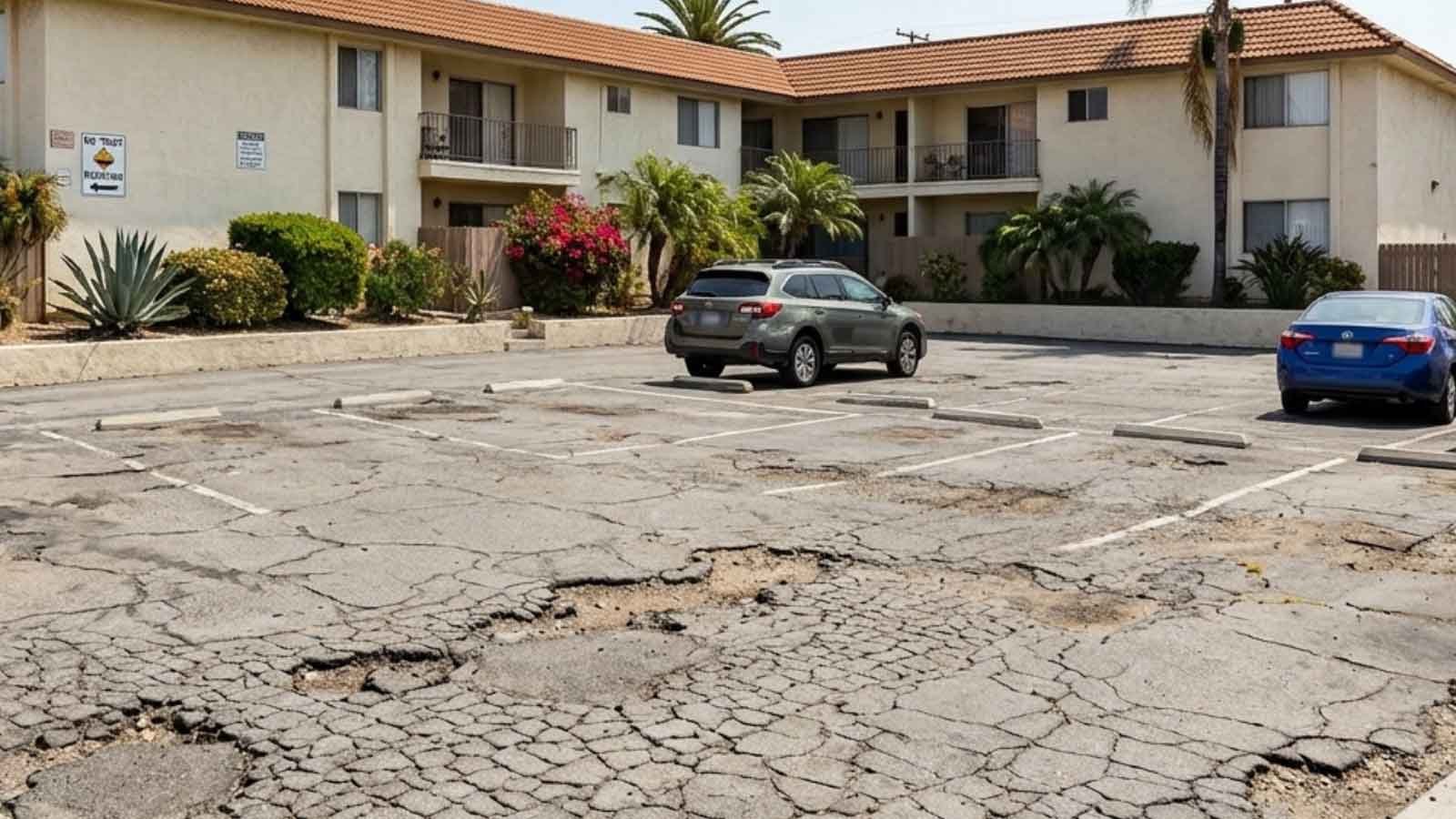
Alligator cracking forms an interconnected, scaled web that resembles reptile skin. You'll find it in drive lanes, loading zones, and the approach to trash enclosures. Anywhere heavy wheels stop, turn, and sit.
This pattern usually indicates fatigue failure. The pavement has repeatedly flexed beyond what its thickness can support, until the cracks run full depth. Sealing the surface of it changes the appearance for a season and nothing more. Of the visual signs on this list, alligator cracking across a meaningful percentage of the lot is among the strongest indicators that repaving deserves serious evaluation.
The Surface Is Raveling
Raveling is a visible sign of advanced asphalt aging. As the pavement deteriorates, the surface begins shedding aggregate, leaving loose stone across the lot. Property managers usually notice it as gravel collecting where gravel shouldn't be, or a drive aisle that feels gritty underfoot.
Some raveling is expected at the edges, around drain inlets, and along seams between old and new sections. Raveling across open drive aisles is a different signal. Traction drops, moisture reaches the pavement more easily, and cracks form faster. Sealcoating a heavily raveled surface won't restore binder that has already broken down.
How Does Water Damage a Parking Lot?
Once water has entered the pavement, the visible warning signs begin to appear. This section focuses on the conditions that reveal moisture-related damage, including drainage problems, settlement, and recurring surface failures.
Standing Water Sits After the Rain Stops
Ponding that lasts more than a day after a storm often means the lot has lost its drainage slope, either through settlement or through a surface that's been ground down and patched until the plane no longer runs where it was designed to.
Walk these spots the morning after rain:
- Low corners of the lot
- Around drain inlets, especially if the pavement has settled at the rim
- Along the curb line, where water should travel and now sits
- Below landscape islands, wherever they drain onto asphalt
Retained water is the more damaging condition, since it has time to work downward. It also creates slip hazards for pedestrians in the meantime. Localized grading can sometimes be corrected through milling and full-depth patching. Widespread slope failure generally can't be corrected, and repaving restores the grades that move water toward the drainage system it was meant to reach.
Runoff and Irrigation Add to the Load
Moving water does different damage. It finds every crack on its way across the lot, and each crack it enters tends to widen. Drainage is one reason two lots built the same year, in the same city, with the same traffic can be in different condition.
Landscape irrigation is a smaller factor than storm runoff, but it's a persistent one. Overspray onto asphalt is a year-round water source, and it's worth checking sprinkler alignment near pavement edges when raveling shows up in an otherwise healthy section.
Uneven and Sunken Pavement
Depressions, dips, and rippling signal movement below the asphalt. Rippled or shoved areas appear near stop signs, speed bumps, and tight turns, where braking and steering push against a surface that's no longer locked in place.
These conditions commonly trace back to repeated heavy loads, soil settlement, fine material washing out from below, or uneven compaction dating to original installation.
For property managers, these conditions create liability exposure that tends to move faster through a budget approval cycle than aesthetics alone. Dips generate trip complaints, and ripples catch low-clearance vehicles, which puts them on the liability side of the ledger rather than the appearance side. Liability tends to move faster through a budget approval than aesthetics ever will.
Frequent Potholes
An occasional pothole after a wet winter is a patch. When the same pothole reopens within a season, or new ones appear a few feet away, the damage almost certainly extends past the hole's visible edges.
Pay attention to where they cluster. Potholes concentrated in one drive aisle or one corner point to a defined problem area. Potholes appearing across unrelated sections suggest the structure has weakened broadly, which changes the scope of any solution worth paying for.
Read More: What Causes Potholes in Commercial Parking Lots?
How Do You Know Repairs Are No Longer Enough?
This is the sign that matters most to anyone managing a maintenance budget, and it's the one that best separates a lot with years left from a lot that's finished.
The Same Areas Need Attention Every Year
If the same 500 square feet has been patched twice in three years, the patch usually isn't the failure. The pavement around it is.
Repeated repair costs more than the invoice suggests. Each round means another mobilization for the same square footage, another closure that disrupts tenants, and another block on your operations calendar, with no change in the asset's trajectory between visits.
Look at the lot as a whole rather than on a defect-by-defect basis. When patches, crack repairs, and resurfaced sections occupy a meaningful percentage of the pavement, the repair budget may be funding a slower version of the same outcome.
Surface Treatments Are Reaching Their Limit
Once the pavement structure has become unstable, surface repairs sit on ground that shifts under them. In many cases, that's the point at which repaving moves from one of several options to the leading candidate.
Full-depth patching is often the better answer when failure is confined to identifiable areas. It removes and rebuilds the pavement section down through the base, which addresses the cause without committing the whole lot to replacement.
Read More: When is Basic Asphalt Overlay the Best Option for Parking Lot Repair?
Extensive Fading and Surface Wear
Asphalt naturally fades from black to gray as it ages. Color alone is not a reason to repave. Gray asphalt usually needs sealcoating, not replacement. Reapplication is recommended every three to five years for most commercial lots, and Orange County properties often fall toward the shorter end of that range because of the sun.
Fading becomes more meaningful when it appears alongside widespread cracking, drainage problems, or recurring repairs. Together, these signs indicate the pavement is nearing the end of its service life. Sealcoating slows additional oxidation but cannot restore structural integrity.
Striping Will Not Hold
When fresh striping fades or lifts within a year, the problem usually lies with the pavement rather than the paint. Worn, raveling asphalt provides a poor surface for paint to adhere to.
The impact extends beyond appearance. Faded ADA stalls are only one part of accessibility, which also includes slope, dimensions, access aisles, and signage. Fire lane markings must remain clearly visible, while directional arrows and stall lines help maintain safe traffic flow and parking capacity.
The Parking Lot Is Nearing the End of Its Service Life
Age alone does not determine when asphalt should be replaced, but it helps explain the pavement's overall condition. Heavy truck traffic, thin original pavement, and poor drainage can considerably shorten its service life. Two parking lots built in the same year may perform very differently.
Parking lots nearing the end of their service life often develop several issues at once, including cracking, drainage problems, surface wear, and structural fatigue. When these conditions occur together, and repairs no longer last, continued maintenance often delays necessary work.
What's the Difference Between Repaving and an Overlay?
Repaving does not always mean removing every layer of asphalt.
An asphalt overlay works when the foundation underneath remains stable. Contractors mill portions of the existing asphalt first, for good reason. Milling maintains proper elevations at curbs, gutters, and drain inlets, which would otherwise sit low relative to a thicker surface. It removes deteriorated material, and it prevents the trip hazards that form where new pavement meets old at a raised edge.
Full reconstruction typically becomes necessary when the base has failed, settlement is extensive, or drainage problems can't be corrected by resurfacing alone. Both approaches fall under asphalt repair services.
Here's how the options generally sort out:
- Isolated damage on a sound base is a repair. Seal the cracks, patch the potholes, sealcoat on schedule, and the lot keeps performing.
- Damage spread across a sound base often makes a good candidate for overlay.
- Widespread damage with a compromised base typically calls for reconstruction.
One important qualifier: these rarely apply uniformly to an entire lot. A single property often needs full-depth patching in the truck route, an overlay across the customer parking areas, and nothing more than crack sealing along the perimeter. Treating the whole site as a single condition usually means overspending on the healthy sections or underspending on the failing ones.
Read More: What Is An Asphalt Overlay?
What Happens During a Parking Lot Evaluation?
Reading these signs from a photo or a phone call only gets you so far. A lot that needs 4,000 square feet of full-depth repair and a lot that needs to come out entirely can look similar from the parking stall. The difference sits below the surface, where none of the signs above can be measured by eye.
A pavement evaluation typically looks at:
- Surface cracking patterns and their distribution across the site
- Base stability and moisture conditions
- Drainage performance and existing slopes
- Areas of settlement
- Previous repair history
That information lets you choose maintenance, resurfacing, or replacement based on the actual condition of the pavement rather than what's visible from the sidewalk.
Read More: When Is My Asphalt Too Old For an Overlay?
The Empire Pavement Severity Index
The Index sorts pavement failure by how deep the damage runs. Levels 1 and 2 are surface problems that maintenance solves. Level 3 is the turning point, where water has started reaching the base. Levels 4 and 5 are structural, and the only real question at those stages is how much of the lot will be exposed.
|
LEVEL |
CONDITION |
WHAT IT MEANS |
EMPIRE SERVICE |
|
1 |
Cosmetic fading, surface oxidation |
Binder is drying out. No cracking, no structural loss. |
|
|
2 |
Surface cracking, no base involvement |
Cracks are through the wearing course, but the base is sound. |
Crack seal + sealcoat |
|
3 |
Moderate cracking, early base softening |
Water is reaching the base in spots. Still recoverable. |
Partial R&R + sealcoat |
|
4 |
Alligator cracking, base failure in sections |
Fatigue failure through full depth in defined areas. |
Section R&R |
|
5 |
Widespread base failure, structural collapse |
The base is gone across large areas. Surface work can't reach it. |
Full R&R |
What Should You Do Next?
Plenty of lots get repaved before they need to be, and plenty of others defer work until the cost has multiplied. The Empire Pavement Severity Index above gives you a starting point, and a professional evaluation tells you exactly which levels apply and where on your specific property.
Empire Parking Lot Services has assessed and repaired commercial lots across Orange, Los Angeles, Riverside, and San Bernardino counties since 2008. CSLB License #1098884.
Request a free estimate, and we'll tell you what your lot needs, including when the honest answer is that it doesn't need repaving yet.


Comments