Budget for parking lot upkeep as two separate lines: an annual maintenance budget for recurring work such as crack sealing, sealcoating, and striping, and a capital reserve for the eventual overlay or replacement. The ranges in the next section give a planning baseline for parking lot maintenance services.
The facility director wants to know when the next pothole needs patching. The person signing the check wants to know why the line item exists. Both get the same answer, and it is a lifecycle number. Pavement with consistent preventive care reaches year 20 to 25 before it needs full replacement. Pavement attended to only when something breaks tends to need full-depth replacement around year 10 to 12. Every figure in this guide follows from that gap.
How Much Should I Set Aside for Parking Lot Maintenance?
Keep the maintenance line and the capital reserve in separate accounts, because mixing them is where budgets go wrong. The ranges below cover maintenance only and are a starting point, not a quote.
- Under 10,000 square feet: $1,000 to $3,000 per year
- 10,000 to 30,000 square feet: $3,000 to $8,000 per year
- 30,000 to 60,000 square feet: $8,000 to $20,000 per year
- Above 60,000 square feet: $20,000 or more per year
Three budgeting structures fit most commercial properties, and the right one depends more on condition and use than on square footage.
|
Property type |
Budgeting approach |
|
Small, lightly used lot |
Annual maintenance allowance covering inspection, crack sealing, and periodic sealcoating |
|
Medium property with growing wear |
Maintenance budget plus a contingency line for patching and drainage work as defects accumulate |
|
Large or enterprise property |
Formal capital reserve with inspection records and an approval calendar for overlay or replacement |
Sealcoating, applied every 3 to 5 years, typically runs $0.25 to $0.75 per square foot, excluding labor, and is one of the highest-ROI recurring items in any maintenance budget. Striping refreshes follow the same schedule. Both are operating expenses.
The case for funding maintenance comes down to lifecycle cost. Annual crack sealing plus sealcoating every 3 to 5 years is what separates the 20-to-25-year lot from the 10-to-12-year lot, and over a 25-year ownership period that gap becomes a 3x to 5x difference in total pavement spending, because the owner who deferred maintenance pays for at least one extra replacement. That multiple is the number to take into a budget meeting.
A maintenance budget that delays a six-figure replacement by a decade is a far easier sell than a repair request with no context. Understanding how long a maintained lot lasts shows where your property sits on that timeline.
What Does a Parking Lot Maintenance Plan Include?
A maintenance plan is not a repair list drawn up after something fails. It starts with an annual inspection covering cracks, potholes, raveling, standing water, surface wear, and faded markings, then ranks what needs attention and when it needs it.
The schedule should reflect traffic volume, surface condition, and drainage performance, not a calendar date. Standing water deserves its own line in the log, because ponded water deteriorates asphalt faster than any surface-level factor except sustained heavy truck traffic.
Routine Crack Sealing for Water Intrusion Prevention
Crack sealing blocks water from reaching the pavement base. Water intrusion can turn a manageable crack into a structural problem, so sealing active cracks early is the lowest-cost way to slow the process.
A technician should first inspect, seal the active cracks, and flag any that keep widening or recur in the same spot, since repeated cracking often indicates subgrade failure. Professional asphalt crack sealing includes that inspection step, not just the sealant.
Asphalt Sealcoating Every 3 to 5 Years
Sealcoating every 3 to 5 years protects structurally sound asphalt from UV exposure, water, oxidation, and everyday wear. It is not a repair method, and sealcoat applied over alligator cracking hides a problem that keeps getting worse underneath.
Because sealcoating is a recurring budget line rather than a one-time project, the ROI case matters. Is sealcoating a parking lot worth the investment? runs through the numbers.
Localized Asphalt Patching and Pothole Repair
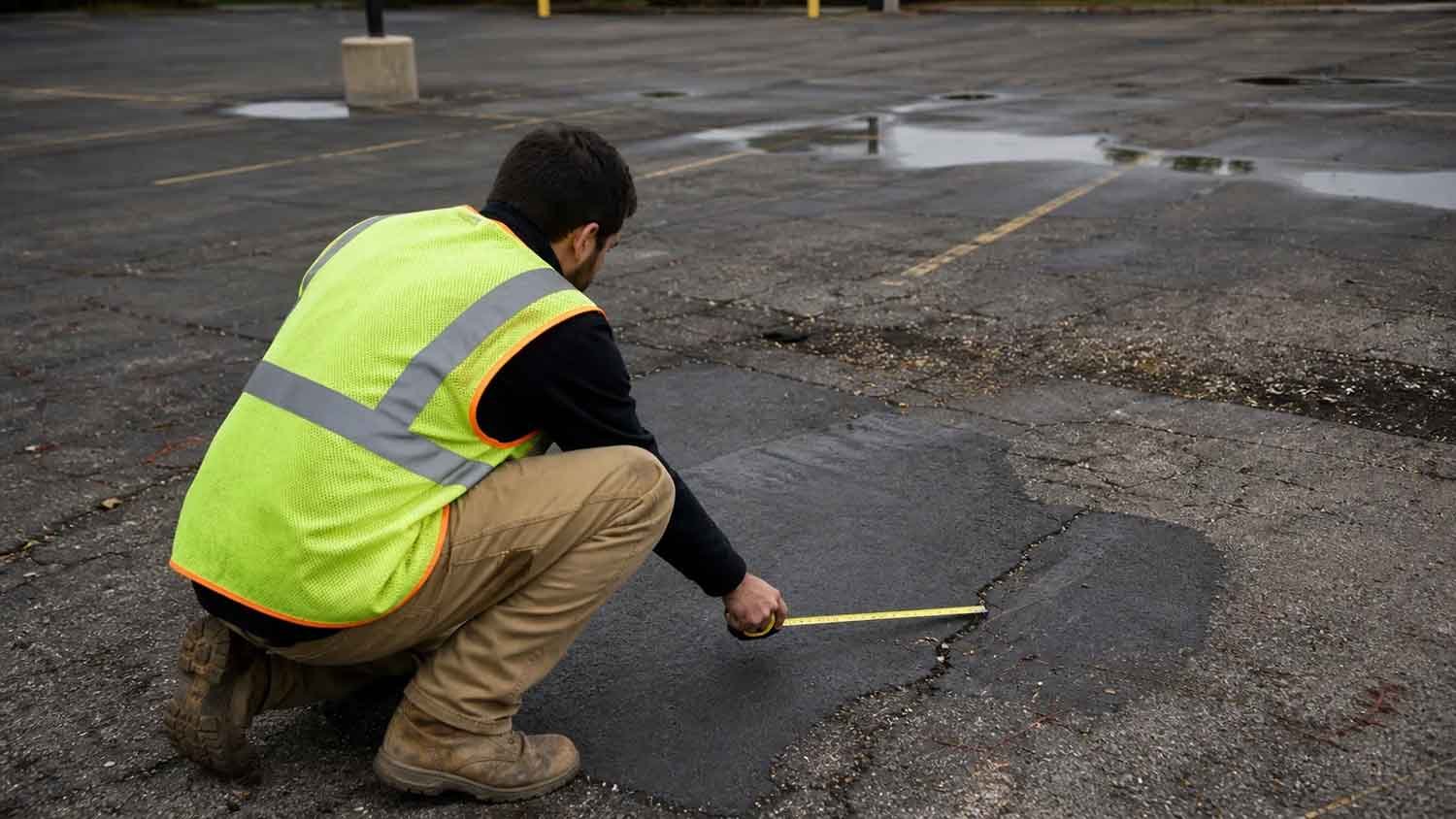
Patching addresses potholes and isolated surface damage before a contained defect spreads, restoring safety immediately. Pothole patching typically runs $150 to $500 per hole, excluding labor, depending on depth and site conditions.
The judgment call comes when patching repeats in the same area. At that point, grinding and an overlay, or, in advanced cases, full-depth replacement, usually costs less than adding more patches to ground that keeps failing. A scheduled asphalt repair assessment should tell you directly whether each failing area is still a patching candidate or has crossed into overlay territory.
Parking Lot Striping and ADA Marking Updates
Faded striping changes traffic flow, reduces usable capacity, and creates fire-lane and safety issues. Restriping runs $0.10 to $0.30 per linear foot, excluding labor, and is usually scheduled with the sealcoat cycle.
An ADA review is needed when markings, ramps, signage, or truncated domes show wear, or when traffic patterns have changed. ADA upgrades bring those elements up to current standards and reduce the property's liability exposure.
How Often Should a Parking Lot Be Repaved?
A well-maintained commercial lot typically lasts 20 to 25 years before it needs to be fully removed and replaced. Before that, an overlay adds 8 to 15 years of service to a lot whose base is still sound.
Repaving is not a calendar event. It becomes the right call when the log shows repeat patching, widespread alligator cracking, or drainage problems surface repairs no longer solve. Assessing where your lot falls on the severity scale tells a board or owner whether the next project is an overlay or a full replacement.
For reserve planning, asphalt overlays currently run $3 to $5 per square foot. That range excludes labor, reflects 2026 California pricing, and is subject to crude oil price fluctuation. Empire Parking Lot Services grinds down a portion of the existing asphalt before placing the new 2- to 3-inch layer, keeping the surface at the original grade and preventing trip hazards.
Is Parking Lot Maintenance a Capital Expense?
Recurring preventive maintenance such as crack sealing and sealcoating is generally an operating expense. An overlay or full-depth replacement is generally a capital expenditure, because it adds value to the asset rather than maintaining what exists.
IRS guidance treats paving as a depreciable land improvement, commonly recovered over 15 years under MACRS. A CPA should confirm the treatment for any specific project, since classification depends on scope and how the work is structured.
For California HOAs, this distinction feeds directly into the reserve study required under the Davis-Stirling Act, which funds major components, such as pavement, before they the needed. A board surprised by a coming overlay has usually skipped that step.
Build the project into the reserve study years ahead, then present it as a phased, multi-year proposal backed by inspection history and photos. Boards approve a plan with a timeline far more readily than one large invoice, and a phased asphalt overlay also gives them a clear way to communicate with residents.
Request an Honest Parking Lot Maintenance Assessment in Orange County
Retail, office, industrial, warehouse, multifamily, and HOA properties across Orange, Los Angeles, Riverside, and San Bernardino counties get the same answer from Empire Parking Lot Services: exactly what the lot needs, no more and no less. A lot that only needs crack sealing and a sealcoat cycle is not sold a bigger scope, and a lot with structural failure underneath is not patched repeatedly when that money belongs in an overlay.
Every project starts with a pre-production site walk with the customer, estimator, and production manager. Experienced foremen oversee the work, end-of-project photos and videos are available on request, and our team tells you where, when, and how long before each phase. We have served Southern California since 2008 under CSLB license #1098884.
Request a free estimate for parking lot maintenance on your property.
FAQs
How often should asphalt parking lots be sealcoated in Southern California?
Every 3 to 5 years, as long as the pavement underneath is structurally sound. Southern California sun exposure and seasonal moisture accelerate oxidation, which asphalt sealcoating is meant to slow.
What causes asphalt parking lots to fail prematurely?
Water intrusion through unsealed cracks is the most common cause, followed by deferred maintenance that allows small defects to become structural problems. Heavy traffic on poorly drained pavement speeds up both.
How does poor drainage impact overall parking lot repair costs?
Standing water turns a section that needed patching into one that needs grinding and an overlay. Left uncorrected, drainage failure expands the scope and cost of every subsequent repair.
How much does crack sealing cost per linear foot for commercial lots?
Typically $0.50 to $2.00 per linear foot, depending on footage, crack severity, and site access. That range excludes labor and shifts as crude oil prices move.
How long does an asphalt overlay last compared to full replacement?
An overlay typically lasts 8 to 15 years when the underlying base is sound. A full removal and replacement lasts 20 to 25 years with consistent preventive maintenance.
Is sealcoating a capital expense or an operating expense?
Generally an operating expense, because it maintains the existing surface rather than adding value to the asset. A CPA should confirm the treatment for your property.
How long does parking lot maintenance work take?
Most sealcoating and striping projects finish in one day, and striping can be applied to dried sealcoat the same day when weather allows. Larger scopes on lots under 20,000 square feet take 2 to 3 days; lots of 20,000 to 60,000 square feet take 3 to 5 days.


Comments