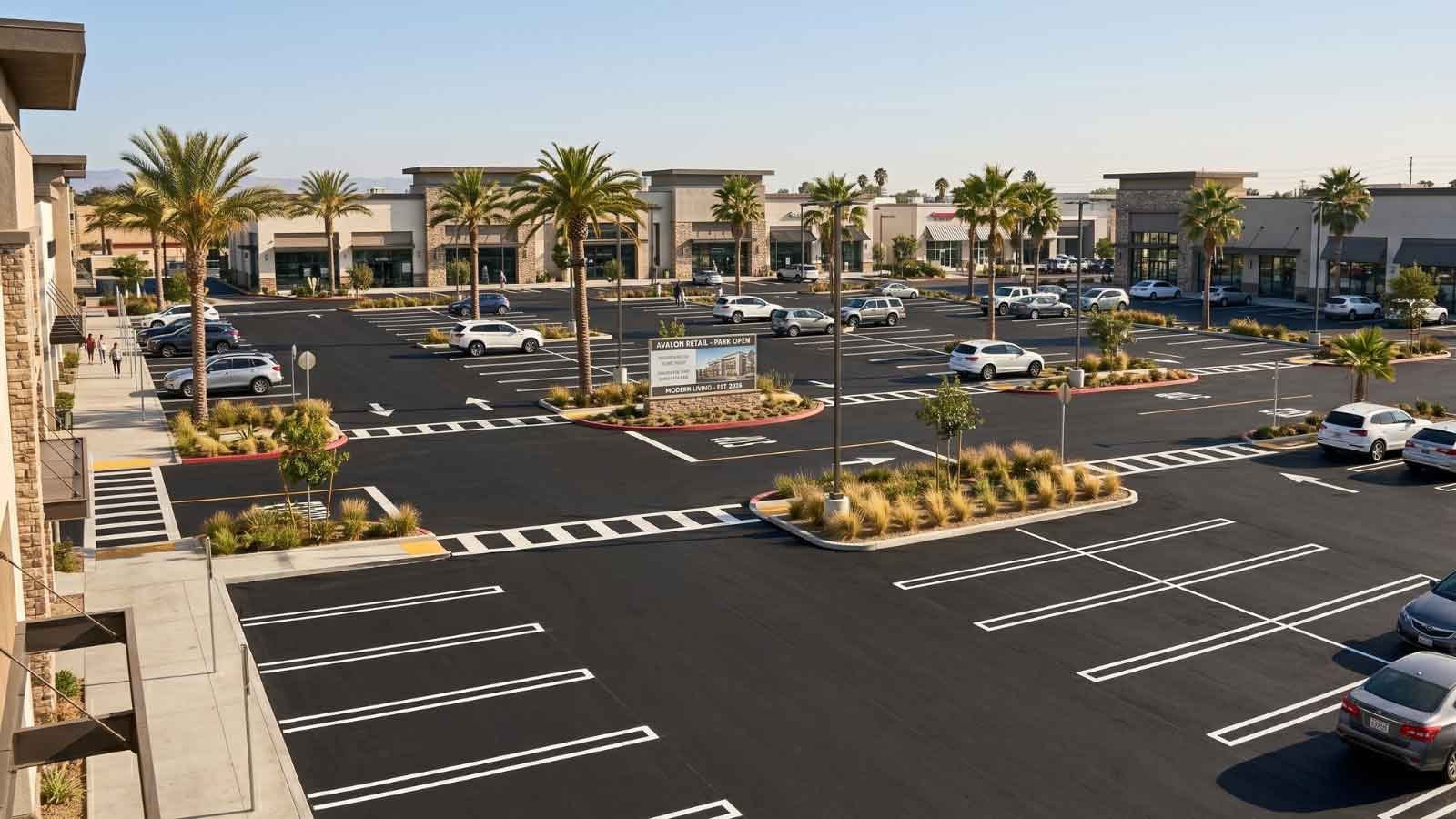
A well-built commercial asphalt parking lot typically lasts 15 to 25 years, and a well-maintained one can last as long as 30 years. The number that applies to your property depends on three things: how it was built, how much punishment it takes each day, and how quickly you address small problems. The rest of this guide walks you through those variables and the decisions they shape.
Structural Failure Starts at the Base
Every question about asphalt parking lot lifespan traces back to one layer: the base. The surface is what you see, but the compacted aggregate and subgrade underneath are what carry the load.
When the base holds, surface repairs work. When the base moves, softens, or loses support, repairs on top of it fail quickly and repeatedly. This is the single most important concept for anyone planning a parking lot budget.
Three things break down asphalt paving faster than anything else:
- Water reaching the subgrade through unsealed cracks or failed drainage
- Heavy or repetitive loads concentrated in the same wheel paths
- Thin lifts, weak compaction, or inadequate aggregate depth at installation
Once the base is compromised, the visible symptoms follow. Cracks widen into interconnected patterns. Potholes return after each patch. Edges crumble along drive aisles. Each of those surface problems is the base telling you something.
What Shapes Your Parking Lot's Lifespan
Four variables determine where your property falls within the lifespan range. Some are set on the day the asphalt paving crew finishes paving. Others must be maintained annually for as long as the lot remains in service.
Installation Quality
Installation sets the ceiling. Proper grading, correct aggregate depth, and asphalt thickness matched to the expected traffic load decide how much your lot can take before needing major work.
You cannot undo shortcuts taken at this stage. Premature cracking, settling, and pothole clusters in lots under 10 years old almost always trace back to the original build.
Read More: Inferior Workmanship: The Hidden Cost of a "Good Enough" Parking Lot in Southern California
Traffic Type and Load
Traffic shapes aging more than almost any other factor. The difference between a passenger-only lot and a truck-heavy lot is measured in years.
- Office buildings and retail centers without loading docks often perform at the upper end of the range
- Lots serving delivery trucks, trash haulers, buses, or box trucks age faster without reinforced wheel paths
- Drive-thru lanes, trash enclosure approaches, and truck turning zones wear out ahead of the rest of the lot
Layout decisions made at installation, like where heavy vehicles enter, turn, and park, influence how evenly the pavement ages.
Climate and UV Exposure
Southern California skips the freeze-thaw cycles that punish asphalt in colder regions, but sun and heat carry their own cost. UV exposure breaks down the binder that holds the surface together, causing it to harden, lose flexibility, and ravel over time.
Seasonal storms add the other half of the equation. Rain runs through small surface cracks and reaches the layers below. Weather plays a role in repair timing, too. Empire contacts customers at least one week ahead of unfavorable weather to reschedule work that needs proper curing conditions, which protects the quality of every dollar spent on your lot.
Water: The Primary Threat
Water is the most destructive force your parking lot faces. It enters through cracks, pooled low spots, and failed drainage, then works downward into the layers that hold everything up.
You will see the damage show up as:
- Alligator cracking across large sections
- Potholes that return in the same locations after patching
- Soft, spongy areas you can feel when walking the lot
- Edge deterioration along curbs and drive aisles
Everything in the sections that follow is, in some form, about keeping water out.
Different Property Types Age Differently
Property type changes the math. Your priorities and budget for parking lot maintenance should vary depending on how your lot is used. A maintained lot is also a property value play, supporting lease rates, tenant retention, and curb appeal, which flow through to ownership returns.
Retail Centers and Shopping Complexes
High vehicle turnover, delivery traffic at loading areas, and customer expectations around appearance make retail lots candidates for consistent sealcoating and parking lot striping cycles. Loading dock approaches, drive-thru lanes, and cart corrals take concentrated punishment and often need targeted patching years before the main lot shows real wear. Faded striping and worn ADA markings also send the wrong signal to shoppers and tenants, so appearance-focused upkeep matters as much as structural repair.
Office Buildings and Corporate Campuses
Passenger-heavy traffic with predictable patterns means these lots often reach the upper end of the lifespan range with routine care. The risk here is the opposite of wear: underuse masks real problems. The same wheel paths are compact while the rest of the lot sits idle, so surface appearance can look fine while drainage issues quietly erode the edges. Planned walkthroughs before each budget cycle catch these problems early.
Industrial Sites and Warehouses
Truck traffic concentrates stress at loading docks, turn radii, and trailer parking. Rutting that would take a decade to appear in a passenger lot can show up within two or three years, where loaded trailers park and turn, and once water pools in those low spots, base failure accelerates underneath. The budget priority is to stay ahead of those zones through targeted full-depth patching. Industrial work often requires phased mobilizations so loading operations can continue while repairs move across the lot in sections.
HOA and Multi-Family Communities
Mixed-use, shared responsibility, and budget approval cycles often push HOA lots into a cycle of deferred maintenance. By the time a repair request reaches the board, gets voted on, and hits the budget, small cracks have widened, and potholes have returned. The properties that stay ahead of this treat the parking lot as a planned capital expense on a phased, multi-year schedule, not as an emergency line item. A phased plan also gives boards a clear visual tool for resident communication.
Building a Parking Lot Maintenance Budget
Budgeting for asphalt is less about a single annual number and more about layering three timelines. Get the layering right, and you avoid the unplanned capital event that catches most properties off guard.
- Annual preventive spend: crack sealing, inspections, minor patching, and re-striping as needed
- Cyclical preservation spend: sealcoating every 3 to 5 years, which protects the binder and delays heavier work
- Long-term capital reserve: funds set aside for an eventual overlay or full replacement, scaled to lot size and current age
The math behind this approach is straightforward. Money spent on prevention is several times less expensive than money spent on emergency repair, and emergency repair is several times less expensive than premature replacement. A maintained lot moves the replacement decision from a 10 to 12 year emergency to a 25 to 30 year planned event, which is the kind of timeline ownership and finance can actually budget around.
The Difference Between Preventive vs. Reactive Maintenance
Maintenance breaks down into two categories. Preventive work keeps a sound lot sound. Reactive work addresses damage that has already started. Every dollar spent on the first usually saves several on the second, which is why the properties with the longest-lasting lots treat maintenance as a planned cycle rather than a response to visible problems.
Preventive: Crack Sealing
Small cracks are the entry point for the most destructive force on your lot. Sealing them while they are still at the hairline protects the layers below and prevents isolated lines from branching into the interconnected patterns that signal deeper failure.
This is one of the lowest-cost, highest-return tasks in parking lot care. It is also the one most often skipped, usually because hairline cracks do not look urgent until they widen into something that is no longer a sealing job.
Reactive: Pothole Repair and Full-Depth Patching
Once damage reaches the layers below the surface, patching is no longer preventive. Full-depth patching removes the failed section down to clean, stable material, then rebuilds it so the repaired area matches the load-bearing capacity of the surrounding pavement. Surface patches over a failed base will fail again, usually within a season or two.
The goal of reactive repair is containment. You fix the failed area before the surrounding pavement begins to pull away from it and before water intrusion turns an isolated pothole into a cluster.
Deferred pothole repair is also a liability issue. Surface defects that exceed a quarter inch in vertical displacement are well-documented trip-and-fall hazards, and the property owner carries that liability whether the lot is leased, managed, or owner-occupied. Acting on potholes when they appear is a legal protection step as much as a maintenance one.
Sealcoating
Sealcoating operates on a different timeline and serves a different purpose than either preventive or reactive repair. It is a protective layer applied across the entire lot surface, shielding the binder from UV, fuel, oil, and water. Without it, the binder holding your pavement together hardens and loses flexibility years earlier than it should.
A typical cycle for Southern California commercial properties is every 3 to 5 years, adjusted based on traffic and sun exposure. Sealcoating does not repair existing damage. It slows the rate at which new damage begins, which is why it works best on lots that are already in sound condition.
Read More: Can Sealcoating Be Used to Fill Cracks?
Repair, Overlay, or Replace: How to Decide
This is the decision you actually need help making. The right answer depends on what your lot looks like now and what its underlying layers are doing.
When Repair Is Enough
- Cracks are mostly hairline and isolated
- Potholes are few and not recurring in the same spots
- Drainage works and water clears within a day of rain
- The lot is under 15 years old with a sound base
At this stage, crack repair and sealing, targeted patching, and your next sealcoat cycle carry the property forward without major capital spend.
When an Overlay Makes Sense
- Surface is worn, faded, or visibly aging across most of the lot
- Cracking is widespread, but the base is still stable
- Ride quality has declined, but you see no soft spots or recurring failures
- The property needs another full service cycle before full replacement is justified
An asphalt overlay extends service life when the base remains stable, at a cost below full replacement.
When Replacement Is the Only Real Option
- Alligator cracking covers large sections
- Potholes return in the same spots after every patch
- Water pools for 24 hours or longer after rain
- Edges are crumbling, and soft areas are spreading
At this point, putting money into surface work is deferring the inevitable. Replacement rebuilds the base, corrects drainage, and resets the full lifespan clock.
Larger projects that combine multiple services, like patching, overlay, and striping in the same scope, are often phased into multiple mobilizations rather than rushed into a single push. Phased mobilization protects quality at each stage, keeps tenant access open during work, and prevents the corner-cutting that happens when crews try to do everything at once.
How to Read Your Lot at a Glance
You can tell a lot about your property before any formal inspection. A quick walk-through gives you enough to know where things stand.
Signs your lot is aging well:
- Surface is uniform in color with no large faded or patched zones
- Cracks, where present, are thin and sealed
- Striping is intact, and drainage is clear after rain
- No soft spots underfoot, no crumbling edges
Signs your lot is in trouble:
- Crack networks are spreading across multiple parking bays
- Potholes reappearing after recent patches
- Standing water for a full day after rain
- Edges breaking away along entrances or dumpster approaches
- Surface feels soft or flexes under foot traffic
These cues tell you if your next step is a sealcoat bid or a replacement plan. They do not replace a professional site evaluation, but they give you a clear starting point for the conversation.
A practical add for any property under management: pull dated photos of the same areas every six months. Year-over-year visual tracking shows you exactly how fast a problem is moving and provides the documentation you need for ownership reports, board packets, and any claim or dispute that comes up later. Empire provides photo and video documentation at the close of every project for the same reason: it is your record of the work and your protection going forward.
Frequently Asked Questions
How often should a parking lot be repaved?
Most commercial asphalt parking lots are repaved every 15 to 25 years, depending on the base condition, traffic load, and the level of maintenance. An overlay placed before the base fails can extend that cycle and delay full repaving by another 10 to 15 years. Full repaving becomes the right call once alligator cracking covers large sections, potholes return after every patch, or water pools long after rain.
How much should I set aside for parking lot maintenance?
A working budget framework spreads spend across three buckets: routine preventive work each year (crack sealing, inspections, minor repairs), a sealcoat cycle every 3 to 5 years, and a long-term capital reserve for an eventual overlay or replacement. The right amount for your property depends on lot size, traffic type, and current condition. A site evaluation gives you specific numbers tied to your lot rather than generic per-square-foot estimates that often miss the mark.
What does a parking lot maintenance plan include?
A complete parking lot maintenance plan typically covers:
- Annual or semi-annual inspections to catch new damage early
- Crack sealing as cracks appear, before water reaches the base
- Sealcoating on a 3 to 5-year cycle for Southern California properties
- Targeted pothole and full-depth patching as needed
- Re-striping to keep traffic flow, ADA compliance, and fire lanes visible
- A multi-year capital plan that anticipates overlay and replacement timing
The right mix depends on property type, traffic, and the lot's current age and condition.
How long after paving can you drive on it?
You can typically drive on new asphalt 48 to 72 hours after paving, depending on temperature, asphalt mix, and weather conditions. Hot weather extends the cure window, and cooler conditions shorten it. Heavy vehicles like delivery trucks and trash haulers should wait longer, and parked vehicles in the same spot for extended periods can leave indentations during the first few weeks while the asphalt fully sets.
Is repaving a parking lot worth it?
Repaving is worth it when the base has failed, and surface repairs no longer hold. At that stage, money spent on patching, crack filling, or sealcoating is deferring the inevitable rather than solving the problem. Repaving rebuilds the base, corrects drainage, and resets the full lifespan clock, which means the property gains 15 to 25 more years of service. If the base is still sound, an overlay is usually the smarter financial move.
When is it too hot to sealcoat?
Surface temperatures above 95°F can cause sealcoat to dry too quickly, weakening the bond and shortening the protective layer's lifespan. The application should also avoid direct, full-day sun on dark pavement during peak summer afternoons. Empire schedules sealcoating around weather and surface conditions to keep the application within the temperature and humidity range that supports proper curing.
Reach Out to Empire PLS for Your Asphalt Needs
Empire Parking Lot Services has worked on commercial, retail, industrial, and HOA properties across Orange County, Los Angeles County, Riverside County, and San Bernardino since 2008. Every project follows Empire's Four S process: Survey, Surface Prep, Safety, and Speed. The result is work that holds up under traffic, on schedule, and without the corner-cutting that catches up with property owners two or three years later.
Empire's commitment to communication is just as defined as the work itself: we will never fail to tell you where, when, and how long. Every project starts with a pre-production site walk attended by you, the estimator, and the production manager, so the scope, sequencing, and access plan are aligned before the first crew arrives. End-of-project photo and video documentation is provided so you have a clean record of the work for your files, your owner, and any future reference you need.
If your lot shows any of the warning signs in this guide, or you want a professional read on where it stands, request a site evaluation and get a quote from us. A walkthrough with a qualified contractor gives you the information you need to plan the next phase of your property with confidence, rather than guessing between repair and replacement. Contact us to schedule your parking lot assessment.
Please refer to our FAQ and Glossary pages if you see any terms or services that you are unfamiliar with.


Comments