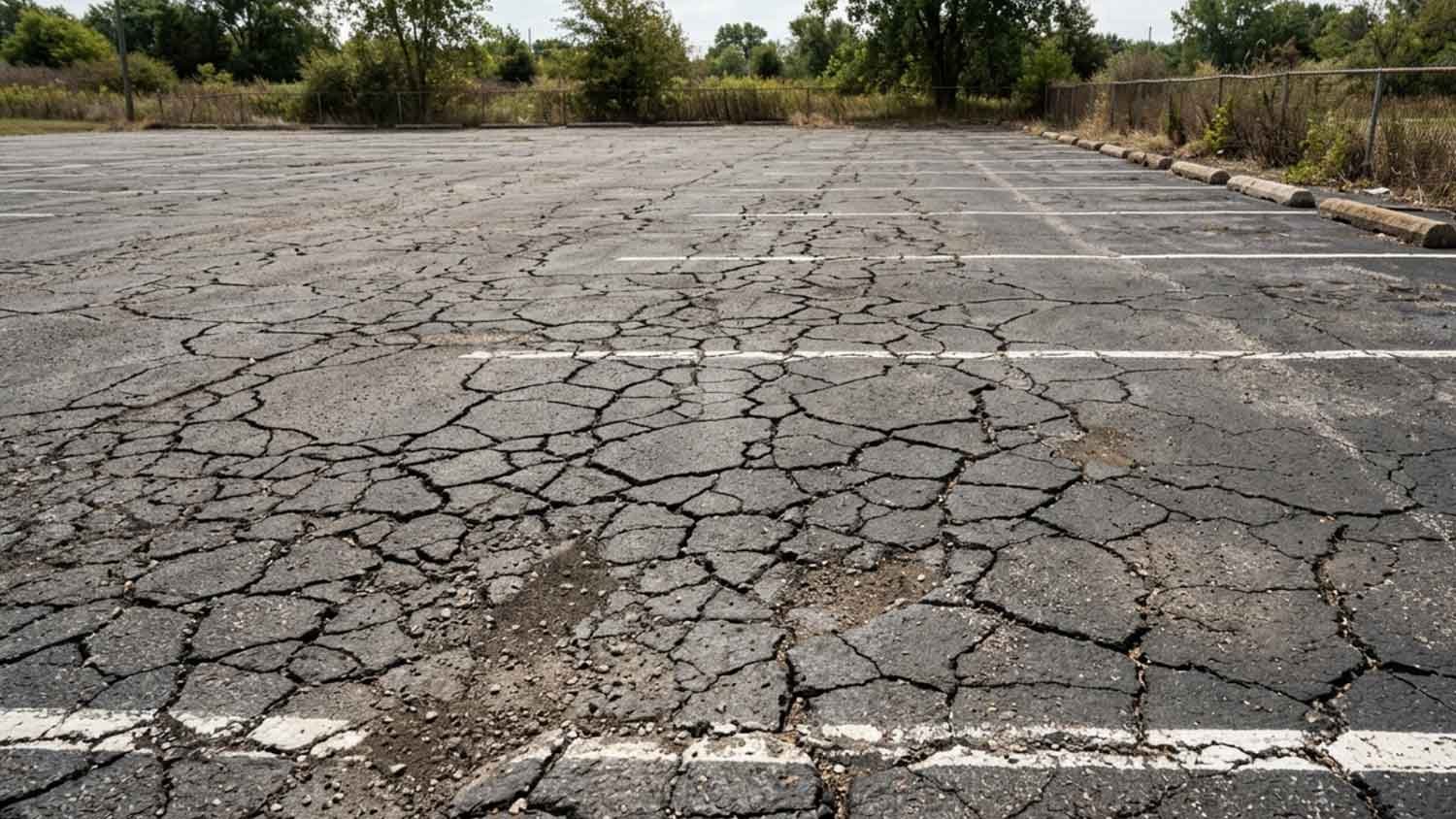
Alligator cracking means the base beneath your asphalt has failed, and the only permanent fix is to remove and replace the failed section with a rebuilt foundation. The interconnected, scale-like pattern is not a surface blemish you can coat over. It is the surface telling you the structure underneath can no longer carry the load. If a contractor offers to sealcoat or patch it and make it disappear, that repair will fail within a season. For property owners and managers across Orange, Los Angeles, Riverside, and San Bernardino counties, the only repair that holds is one that addresses the base, not the surface.
Why Does Alligator Cracking Look Like Alligator Skin?
The pattern comes straight from the mechanics of the failure. When the base loses strength, it no longer supports the asphalt evenly. Every time a vehicle passes over, the surface flexes downward into the weak spot, then springs back. Asphalt tolerates that flexing for a while, then fatigues and cracks.
Those cracks do not form randomly. They radiate out from the stressed area and connect, breaking the surface into small, many-sided pieces that resemble the scales on an alligator's back or a dried lakebed. The pattern is a map of where the pavement deflects under load, which is why it clusters in wheel paths, entrances, loading zones, and turning areas: the spots where load concentrates on the same footprint day after day.
Seen early, the pieces stay tight and stable. As the base continues to give way, the pieces loosen, edges ravel, and in advanced stages sections move underfoot or under a tire. Once pieces are shifting, water has an open path into the base, and the decline accelerates.
What Causes Alligator Cracks in Asphalt?
The root cause is always the same: the base can no longer support the traffic above it. What varies is how the base got there. A few conditions do most of the damage in commercial lots.
- Weak or under-built base. A base that was poorly compacted or built too thin for the traffic it carries never had the strength the lot needed. It fails early, often in the heaviest-use zones first.
- Traffic heavier than the design. A lot built for passenger cars starts taking regular delivery trucks or refuse trucks, and the concentrated weight fatigues pavement that was never engineered for it.
- Water in the base. This is the accelerant, and in Southern California it is the one that turns a slow problem into a fast one. Not every crack pattern points to base failure.
If you are still working out what type of cracking your lot has, our guide on how to distinguish structural from cosmetic cracks walks through the diagnostic signs in detail.
The SoCal Factor: Atmospheric Rivers, Not Freeze-Thaw
Colder regions lose pavement to freeze-thaw, in which trapped water freezes, expands, and splits the asphalt over the winter. Orange County does not work that way. Southern California lots bake dry and develop hairline cracks through months of heat, then an atmospheric river arrives and drops a season's worth of rain in days.
A sound, well-drained lot sheds that water. A lot that already has open cracks takes on more water than its drainage can handle, and the water runs straight to the base. Once there, it washes out the fine material binding the aggregate, and the foundation loses strength fast. A single wet season on a cracked, neglected lot can accelerate that deterioration by years, often within 6 to 12 months of sustained saturation. Once the base fails, the same process that creates potholes takes hold, and widespread alligator patterns often show up by early fall.
Can You Sealcoat Over Alligator Cracking?
No. This is the single most important thing to understand about this distress, and it is where our team of asphalt contractors here at Empire Parking Lot Services will tell you something other contractors may not.
Sealcoat is a thin liquid coating. It protects healthy asphalt from UV and water, and it has a real place on a sound lot. It adds no structural strength whatsoever. Applied over alligator cracking, it does one thing: it hides the pattern for a few weeks under a fresh black finish. The base is still failing underneath. The cracks telegraph back through, and after the first heavy rain the coated area breaks down exactly as it would have without the coating, except now you have paid twice.
A contractor who quotes sealcoat as the fix for alligator cracking is either misreading the distress or selling you a cosmetic result that will not last the season. The honest path costs more up front and saves you from paying for the same area twice. Surface treatments protect pavement that still has a working foundation. They cannot rebuild one that has failed.
Can You Overlay Alligator Cracking?
Not as a standalone fix, and for the same reason. An overlay places a new layer of asphalt over the existing surface. If the base below is still failing, the new layer inherits the same lack of support and cracks through within a season or two, often reflecting the exact pattern it was meant to cover.
An overlay earns its place only when the base is sound. Only after the base is assessed, repaired, and confirmed stable can an engineered overlay become part of the solution. That is why the base has to be assessed and repaired first. Where the remaining structure is suitable after that work, an engineered asphalt overlay can be part of the solution. Applying an overlay to active base failure is money spent on a temporary fix, not a permanent one.
How Do You Fix Alligator Cracks?
Successful crack repair addresses the base, because the base is the problem. There is no surface-only version of this fix that lasts. The correct sequence looks like this:
- Remove the failed section down to the base. The compromised asphalt is removed entirely, cutting back to structurally stable edges.
- Repair the foundation. The failed aggregate base is recompacted or replaced, and any drainage issues that cause water to enter the area are corrected. Skipping this step is what guarantees the repair fails.
- Install new asphalt. A properly compacted new asphalt section is installed and bonded to the surrounding pavement.
For damage confined to a defined area with sound pavement around it, this section repair restores the lot without touching the rest. When the alligator pattern has spread across a large share of the surface, section-by-section repair no longer makes financial sense, and full removal and replacement of the lot becomes the only permanent solution. Deciding when full replacement is the only fix comes down to how much of the lot has actually failed.
On cost: a defined-section repair typically runs $5,000 to $30,000, while full removal and replacement of a commercial lot generally ranges from $20,000 to $200,000 and up. The total scales directly with how much of the lot has lost its base, which is why the ranges overlap at the edges; a large multi-section repair can exceed the cost of replacing a small lot outright. Asphalt pricing moves with the crude oil market, so these ranges reflect current conditions and are subject to change. Every lot's condition also differs, which is why Empire prices each project after an on-site assessment rather than quoting a blanket figure. That assessment is where the real answer comes from.
How Empire Determines Section Repair vs. Full Replacement
The pattern on the surface tells our estimators where to look. It does not, by itself, tell them how far the failure reaches. That takes an on-site evaluation, and it is the step that separates an accurate scope from a guess. When an Empire estimator walks your lot, they assess:
- How much of the lot shows the pattern, and whether it is confined to specific zones or spread across the field
- Where it concentrates, since clustering in wheel paths and loading areas confirms base fatigue rather than surface aging
- How the pieces behave underfoot and under a vehicle, since movement signals advanced structural loss
- Drainage and grade, because standing water, low spots, and failed curbs point to the source feeding the base
- The condition of the surrounding pavement, which determines whether a section repair has sound edges to bond to
That evaluation produces a scoped recommendation: isolated section repair where the failure is contained, or full replacement where it is not. Being direct about which approach your lot actually needs, including when that means recommending the larger project, is how Empire builds long-term relationships rather than closing a quick sale on a repair that fails by winter.
Frequently Asked Questions About Alligator Cracks
What Happens If You Ignore Alligator Cracking?
Alligator cracking does not stay confined to the surface. As the weakened base continues to deteriorate, the cracked area spreads, pieces of asphalt begin to loosen, and potholes often develop. Delaying repairs can turn a localized reconstruction into a much larger and more expensive replacement project.
How Quickly Does Alligator Cracking Spread?
The rate depends on traffic, weather, and the condition of the base beneath the pavement. Commercial lots with frequent truck traffic or poor drainage can deteriorate much faster than lightly used parking areas. Once water reaches the base, the damage often accelerates after heavy rain.
Can Heavy Trucks Cause Alligator Cracking in a Parking Lot?
Yes, especially when the pavement was not designed for repeated heavy loads. Delivery vehicles, garbage trucks, and loading operations place concentrated stress on the asphalt. Over time, that repeated loading can fatigue the underlying base and lead to the interconnected cracking pattern associated with structural failure.
Can New Asphalt Develop Alligator Cracking Too Soon?
It can if the underlying problem was never corrected. Installing new asphalt over a weak base, using an inadequate pavement design, or failing to address drainage issues can allow structural cracks to return much sooner than expected. Long-lasting repairs begin with a stable foundation.
How Long Does a Full-Depth Asphalt Repair Typically Last?
A properly constructed full-depth repair can provide many years of service when the failed base is rebuilt, drainage issues are addressed, and the pavement receives routine maintenance. The lifespan ultimately depends on traffic loads, site conditions, and the quality of parking lot maintenance after the repair.
How Much Does It Cost to Fix Alligator Cracking?
A full-depth section repair generally runs $5,000 to $30,000. Full removal and replacement of a commercial lot typically falls between $20,000 and $200,000 or more. The range is wide because cost tracks the failed area, the repair depth, total square footage, and current asphalt pricing, which moves with the crude oil market. These figures reflect current market conditions and are subject to change. An on-site assessment is the only way to determine whether a specific lot falls within that range.
Get Your Parking Lot Assessed Before the Damage Spreads
Alligator cracking is a sign of structural failure, but it does not always mean your entire parking lot needs to be replaced. The key is determining how far the damage extends beneath the surface.
Empire Parking Lot Services performs on-site evaluations for commercial properties across Orange, Los Angeles, Riverside, and San Bernardino counties. Every assessment produces a written project scope with specific, honest recommendations so you understand exactly what your lot needs before committing to any scope of work. Request a site assessment and get a quote. Empire Parking Lot Services holds California Contractor's License #1098884.


Comments