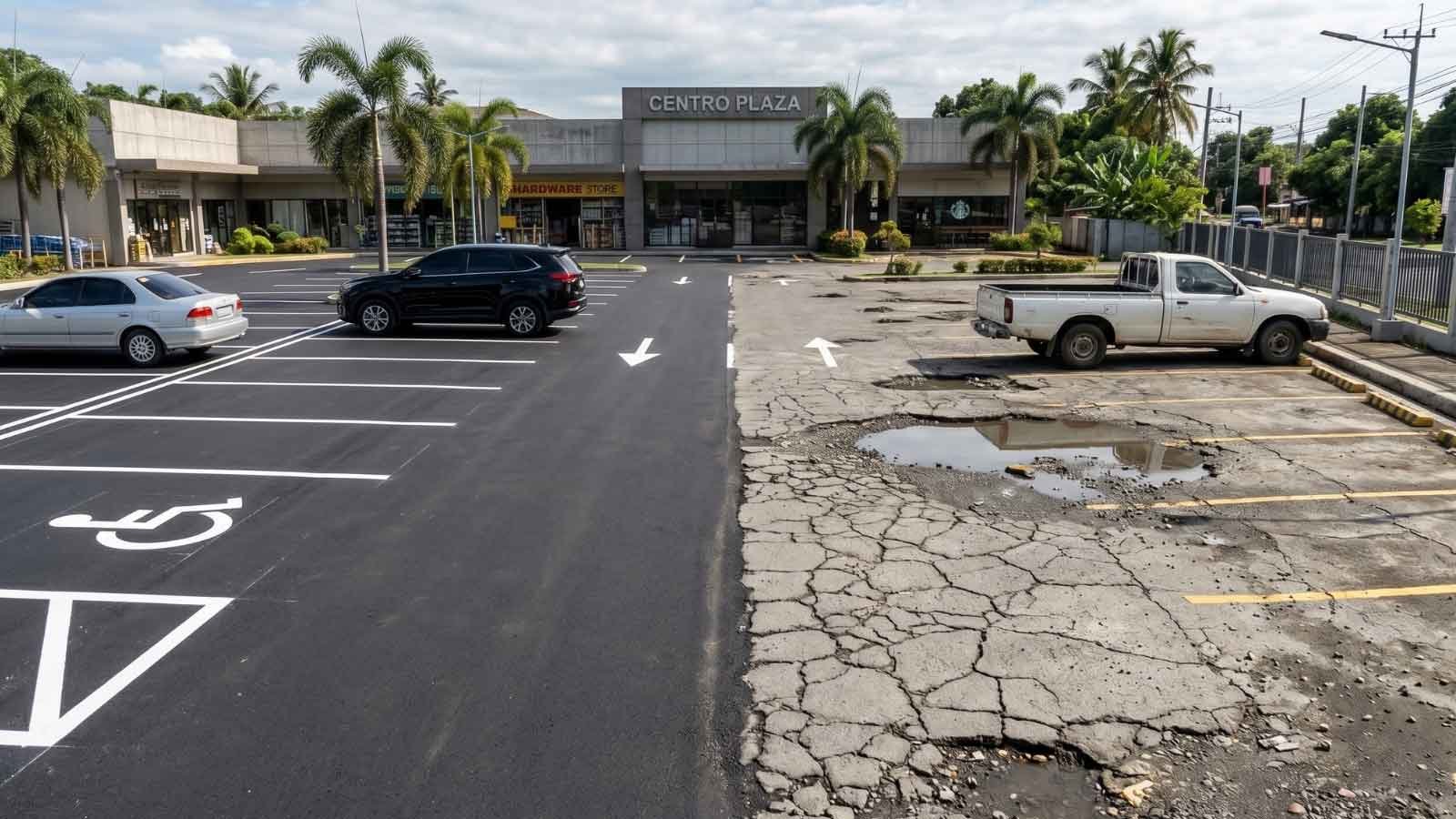
You're holding two bids, or maybe one bid with two options, and the question is which way to go. Resurface for less now, or replace for more upfront and a longer runway. Both can be right. Both can be wrong. The deciding factors are what's actually happening beneath your pavement, your budget cycle, and how long you plan to hold the property.
This guide gives you a working framework to read your own lot before the contractor walks it, so you know what to ask and what to push back on.
The Core Question Behind Resurface vs. Replace
The decision isn't really between two products. It's between protecting short-term cash flow and protecting long-term structural integrity. The right choice depends on the lot, not on a default playbook.
Parking lot resurfacing lays a new layer of asphalt over your existing pavement. You keep the structural foundation already in place, get a clean driving surface, and stay open in a fraction of the time it takes to rebuild.
Full parking lot replacement removes the existing pavement and rebuilds the entire structure. You start over with a foundation engineered for the next two decades of traffic, and you get the chance to fix problems an asphalt overlay can't reach.
|
Factor |
Resurface |
Replace |
|
Base condition |
Sound, no soft spots |
Failing, soft spots, drainage breakdown |
|
Surface damage |
Cracks, fading, light raveling |
Alligator cracking, recurring potholes |
|
Hold horizon |
Under 5 years |
10+ years |
|
Project timeline |
2 to 5 days for most lots |
1 to 3 weeks, depending on the demolition scope |
|
Layout changes needed |
None |
ADA, drainage, or striping rework |
|
Material cost (2026 CA rates) |
$3 to $5 per sq. ft. for 2" overlay |
$5 to $8 per sq. ft. for 4" remove and replace |
Pricing covers materials only, excludes labor, and is tied to crude oil pricing. If your lot lands clearly on one side of every row, you have your answer. If it splits, the sections below help you weigh the tradeoffs.
The Middle Ground That Most Articles Skip
Resurface vs. replace is rarely a clean binary. Three intermediate approaches solve a lot of decision tension:
- Mill-and-overlay: a deeper version of the milling step that Empire's overlay process already includes. More material gets ground off before the new layer goes down, which controls elevation, removes damaged surface material, and gives the new asphalt a clean bond. For lots that have been overlaid before, this is often what makes another overlay viable.
- Full-depth patching: failed sections get cut out, the base in those spots gets repaired, and new pavement gets keyed in. The rest of the lot gets resurfaced. Works when base failure is localized rather than lot-wide.
- Partial reconstruction: one drive lane or one section gets fully rebuilt while the rest is overlaid. Common on larger commercial properties where traffic concentrates damage in predictable zones.
If an asphalt contractor only quotes you for resurfacing or replacement, ask about these hybrids. You may be leaving options on the table.
When Resurfacing Is the Right Call
Resurfacing is the high-value move when your foundation is intact, and the damage hasn't reached the base layer.
Your Base Is Still Sound
The asphalt base is the load-bearing layer underneath the visible surface. If it's holding up, an overlay extends your lot's life at a meaningful discount to a full rebuild. Look for these indicators:
- No visible flex when heavy vehicles pass over the surface
- No soft spots underfoot
- No standing water in areas that previously drained correctly
- No recurring cracks reappearing after past patches
If two or more of these check out, you're likely in overlay territory.
The Damage Is Surface-Level Only
Light surface cracking, faded color, minor raveling, and rough texture are all issues an overlay can solve. Most commercial overlays call for 1.5 to 2.5 inches of new hot-mix asphalt, with thickness depending on traffic volume and vehicle weight. Paving contractors seal active cracks and patch deteriorated spots before the new layer goes down, so the overlay bonds to a clean, stable surface.
Read More: How Thick Should a Commercial Asphalt Parking Lot Be?
You Need a Faster Turnaround
Project timing is one of the biggest reasons property managers favor resurfacing:
- Lots under 20,000 square feet: 2 to 3 days
- Lots between 20,000 and 60,000 square feet: 3 to 5 days
- Larger multi-phase projects: scheduled in stages so portions of the lot stay accessible
A full replacement, by comparison, runs 1 to 3 weeks depending on the demolition scope. That difference matters most for retail centers, medical offices, multi-family communities, and any property where extended closure isn't realistic.
When Full Replacement Makes Financial Sense
Replacement is the right call when surface fixes won't hold. Layering new asphalt over a compromised base buys you a year or two of cosmetic improvement and forces the rebuild anyway.
Signs of Base Failure
These are the conditions that signal your lot needs more than an overlay:
- Alligator cracking: interconnected cracks resembling reptile skin, which means the base is flexing under load
- Recurring potholes: deep potholes that come back in the same spots after patching, pointing to water intrusion below the surface
- Soft spots and sinking sections: areas where the pavement gives underfoot or has visibly settled
- Pooled water in formerly dry zones: drainage failure that signals the sub-base is no longer holding grade
When several of these show up together, an overlay typically produces reflective cracking inside a couple of years on lots with heavy traffic. Lighter-use properties may get more time, but the underlying problem doesn't fix itself.
Read More: Can Sealcoating Be Used to Fill Cracks?
Drainage and Grade Correction
Pooled water signals more than a tired surface. It usually means your lot has lost grade or the sub-base has settled unevenly, and resurfacing inherits whatever slopes the existing lot has. A full replacement is the right moment to:
- Re-establish positive drainage slopes toward inlets
- Repair or replace failed sub-surface drainage where present
- Re-engineer ponding zones that have been a recurring problem
Stacked Overlays Hitting a Ceiling
Each overlay adds height. Over time, that elevation conflicts with curbs, drainage inlets, doorway thresholds, and ADA grade transitions. Multiple layers also don't always bond as one cohesive surface, which causes reflective cracking from layers buried two or three rebuilds back.
Milling can extend the runway, but once it can't recover enough depth or grade, replacement is the right call.
You Are Holding the Property Long-Term
Lifecycle math tends to favor replacement for owners planning to hold for a decade or more. You avoid stacking repair costs on a tired base and the productivity loss of repeated parking lot maintenance projects. If you're planning to sell or refinance within five years, the math more often favors resurfacing, since the next owner inherits the longer-term decision.
Five Decision Drivers Property Managers Should Weigh
Before requesting bids, run your lot through these five filters.
Current Pavement Condition
Walk the lot before any contractor arrives. Note where water pools, where cracks have spread, and where past patches have been redone. Photograph what you see so you can compare what each contractor tells you against what you saw firsthand.
Capital Budget and Hold Horizon
Match the investment to your ownership timeline. At the current 2026 California material rates:
- 2-inch overlay: $3 to $5 per square foot
- 4-inch remove-and-replace: $5 to $8 per square foot
Both ranges cover materials only, exclude labor, and shift with crude oil pricing. Final project cost depends on lot size, surface condition, prep work scope, and scheduling logistics, so request a site-specific bid before locking the budget.
Tenant and Customer Disruption Tolerance
Different property types absorb project timelines differently:
- Retail centers and medical offices typically favor a faster overlay timeline or phased work to keep entrances open
- Industrial sites and warehouses can absorb a full replacement during scheduled downtime
- Multi-family communities and HOA properties need clear resident communication, and both options work with the right phasing plan
Aesthetics, Branding, and Curb Appeal
A resurfaced lot looks dark, smooth, and freshly striped, which signals to your tenants and customers that the property is well-managed. A full replacement gives you a cleaner moment to reconsider parking lot striping layouts, traffic flow, accessible parking placement, and crosswalk design. If your current layout has been a problem for years, replacing it is the cleanest way to fix it.
ADA Compliance and Layout Modernization
A full rebuild is the easiest moment to bring slopes, ramps, accessible spaces, and truncated domes up to current standards. The pavement is already coming up, so adjusting elevations costs less than retrofitting later. Resurfacing preserves your existing layout, which works fine if the lot was already compliant; if it wasn't, an overlay can lock in the same problem and shift grade transitions further out of spec by adding pavement height. Restriping after either project may also trigger an updated compliance review, depending on local code, so ask your contractor which items get re-inspected before work starts.
Lifespan Expectations and What Affects Them
Two ranges show up everywhere in this conversation, and both come with conditions:
- Overlay lifespan: typically 8 to 15 years on a sound base, with the top end requiring routine maintenance and lighter traffic loads
- Full replacement lifespan: 20 to 30 years for properly built pavement, paired with timely repairs
Real-world performance depends on three variables:
- Traffic load: an industrial lot with daily semi-truck traffic won't perform like a small retail lot
- Maintenance discipline: cracks sealed when they appear, potholes patched early, and a sealcoating program every 3 to 5 years protects the investment
- Drainage quality: water is the most common pavement killer, so a lot that drains well outlasts one that ponds
Climate is less of a factor in Southern California than in freeze-thaw regions, but UV exposure, oil leaks, and heavy summer heat still erode unprotected asphalt over time.
Common Questions Property Owners Ask
Can I Resurface a Lot That Has Already Been Overlaid?
Often yes, if milling brings elevation back into range and the base is still sound. The check is whether grade transitions at curbs, drains, and doorways still work after the new layer goes down. If the math doesn't work, replacement is the right move.
Will Resurfacing Hide Existing Cracks?
Surface-level cracks can be sealed and repaired before the new layer is applied. Base-driven cracks will telegraph through the new surface within a year or two, regardless of prep. Why a crack is there matters more than how it looks at the surface.
Is Mill-and-Overlay the Same as Resurfacing?
It's a version of resurfacing with an extra step. The top layer gets ground off before the new asphalt goes down, which controls elevation and gives the new surface a cleaner bond. For lots that have been overlaid before, this approach is often the only way another resurface makes sense.
What Triggers a Required ADA Update?
Restriping after major work, and any project that alters grade, slope, or accessible parking placement, can trigger an updated compliance review under local code. ADA upgrade specifics vary by jurisdiction, so confirm with your contractor which items get re-inspected before work starts.
The Bottom Line
If your base is sound, your damage is surface-level, and you need to be back open in days, resurfacing is usually the right move. If you're seeing alligator cracking, recurring potholes, soft spots, or drainage failure, replacement is the move that actually solves the problem. Hybrid approaches handle most of the cases that fall in between.
Empire Parking Lot Services has been working on commercial, industrial, and retail properties across Orange County, Los Angeles County, Riverside County, and San Bernardino County for 17 years (CSLB license #1098884). Foremen oversee every project, and photo or video documentation of site conditions is available on request. Contact us and request a site visit to get a read on your lot before deciding.


Comments