
A commercial asphalt parking lot needs 3 to 4 inches of asphalt for light-duty traffic, 4 inches for medium-duty traffic, and 6 inches or more for heavy-duty traffic such as semi-trucks and loading docks. Aggregate base depth ranges from 6 to 12 inches, depending on traffic load and subgrade conditions.
On paper, the answer is simple. In practice, it's one of the most commonly misunderstood parts of any commercial asphalt paving project.
Thickness isn't just a construction detail. It's a design decision that affects performance, parking lot maintenance cycles, and long-term costs. Yet it is often reduced to a single number on a bid sheet, with little explanation of what that number actually represents. That gap is where expensive problems tend to start.
Before you can evaluate whether a proposed asphalt section is appropriate, you need to understand what those thickness numbers are actually based on and why two parking lots that look similar on the surface may be built very differently underneath.
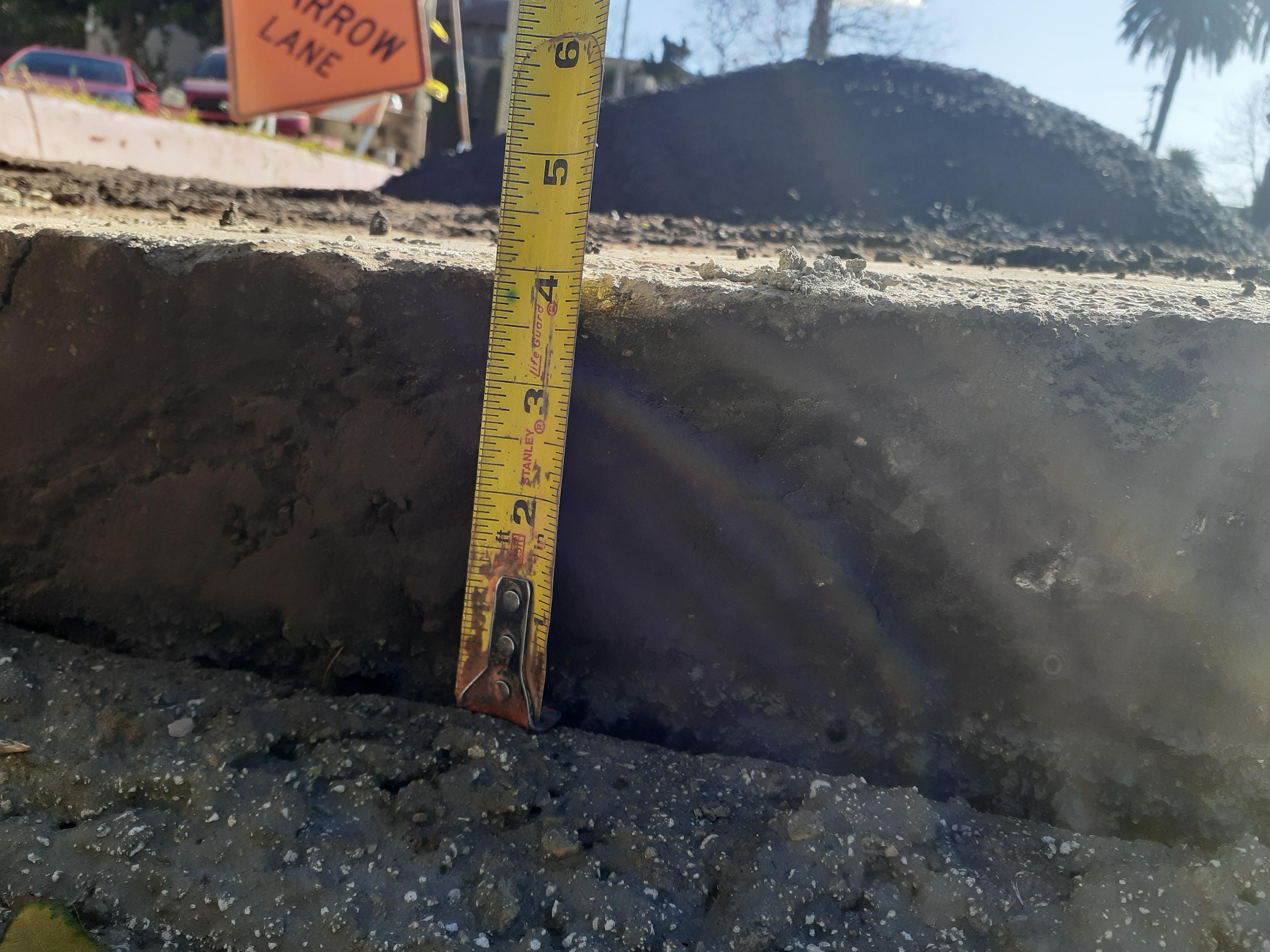
The Three Layers That Carry Your Parking Lot
The three layers of a commercial asphalt parking lot are the subgrade, the aggregate base course, and the asphalt surface course. Each does a distinct job, and when one underperforms, the layers above it cannot make up the difference.
Thickness specifications only work in conjunction with proper drainage. Standing water accelerates failure regardless of how thick the asphalt is, because water that sits on the surface or pools at low spots eventually finds its way through to the base. A correctly specified lot with poor drainage will fail faster than a thinner lot with graded surfaces to shed water. Slope, drain placement, and the transition between the asphalt and adjacent structures all factor into a thickness decision.
Subgrade: Stability
The subgrade is the native or compacted soil at the bottom of the system. Its job is to stay stable under load, in both dry and wet weather. Everything above it depends on this layer holding its shape.
Proper subgrade preparation requires:
- Removing organic material such as roots, topsoil, and buried debris that decompose over time and create voids
- Compacting the soil to 90 to 95 percent relative compaction
- Grading for proper drainage so water moves off the subgrade rather than sitting in it
- Identifying and addressing soft spots before any base material goes down
Water damage to the subgrade is the primary cause of asphalt failure in Southern California. Get this layer wrong, and nothing above it can compensate.
Aggregate Base Course: Load Distribution
The aggregate base sits between the subgrade and the asphalt. Its job is to distribute concentrated tire loads across a wider subgrade footprint, so the soil below never sees the full point load of a vehicle wheel.
Three details determine how well the base actually performs:
- Compaction matters as much as depth. A well-compacted 6-inch base outperforms a loose, poorly compacted 8-inch base every time.
- Aggregate gradation matters. A well-graded mix of stone sizes locks together under compaction. Single-size aggregate shifts under load.
- Moisture content at compaction matters. Aggregate compacted too dry or too wet will not reach the target density, regardless of how many roller passes it gets.
Base depth scales with traffic load:
- Light-duty commercial lots: 6 inches
- Medium-duty lots: 6 to 8 inches
- Heavy-duty or industrial applications: 8 to 12 inches
- Expansive clay subgrades: add 2 to 4 inches beyond standard to absorb soil movement
Read More: Inferior Workmanship: The Hidden Cost of a "Good Enough" Parking Lot in Southern California
Asphalt Surface Course: Wear and Durability
The asphalt surface course is the top layer, a hot-mix asphalt blend of aggregate, sand, and asphalt cement. Its job is to handle direct contact with tires, weather, and oil drips without rutting or cracking. Commercial parking lots typically use a 1/2-inch maximum aggregate gradation to balance smoothness with structural strength. Heavier-traffic applications sometimes use 3/4-inch aggregate for the base lift of asphalt, with a 1/2-inch surface lift on top.
When asphalt gets placed in two lifts like this, a tack coat between them bonds the layers into a single structural unit. Skipping the tack coat lets the surface lift slide under traffic and shortens the section's effective life.
Thickness Specifications by Traffic Type
Asphalt thickness ranges from 3 inches for light-duty traffic up to 8 or more inches for industrial applications. Traffic load is the single biggest factor driving thickness, and the table below covers the four common use cases.
|
Traffic Type |
Asphalt Thickness |
Aggregate Base |
Full-Depth Alternative |
|
Light-duty (cars, light SUVs) |
3 inches |
6 inches |
4 inches of asphalt, no base |
|
Medium-duty (delivery vans, box trucks) |
4 inches |
6 to 8 inches |
5 to 6 inches full-depth |
|
Heavy-duty (semi-trucks, loading docks) |
6 inches |
6 to 8 inches |
7.5 to 10 inches full-depth |
|
Industrial (forklifts, container handlers, heavy equipment) |
8+ inches |
8 to 12 inches |
10 to 12 inches full-depth |
Full-depth alternatives use thicker asphalt placed directly on a prepared subgrade, with no aggregate base in between. They're useful when site conditions, drainage limits, or scheduling make a separate base course impractical.
Light-Duty Lots (Passenger Cars, Light SUVs)
Light-duty applies to most commercial properties:
- Office buildings
- Retail centers
- Medical plazas
- Multi-family communities
The functional minimum is 3 inches of compacted hot-mix asphalt over 6 inches of aggregate base, or 4 inches of full-depth asphalt.
The most common cost-cutting move on light-duty lots is for contractors to specify 2 inches of asphalt to win on price. Two inches looks identical to 3 inches the day it's laid. The difference shows up at year 4 or 5, when the thinner section starts cracking, and the thicker one doesn't.
Medium-Duty Lots (Delivery Vans, Box Trucks, Mixed Traffic)
Mixed-use retail centers with daily delivery truck activity, urgent care facilities with ambulance access, and small industrial parks fall into this range. The build moves up to 4 inches of asphalt over 6 to 8 inches of base.
Wear patterns here are concentrated in delivery routes and traffic lanes. Some specifications call for thicker asphalt in the approach lanes and standard depth in the parking stalls. Variable-thickness design saves material costs without compromising performance where it matters.
Heavy-Duty Lots (Loading Docks, Semi-Trucks, Heavy Equipment)
Distribution centers, warehouse loading areas, and any lot regularly hosting tractor-trailers require a minimum of 6 inches of asphalt over a 6- to 8-inch compacted aggregate base, with thicker specifications at loading-dock approaches and main travel lanes. Heavy-duty commercial paving projects of this scope warrant on-site evaluation before any thickness number gets finalized. Full-depth designs run 7.5 to 10 inches of asphalt directly on a properly prepared subgrade.
Loading dock approaches deserve special attention. Static loading zones where trailers park for extended periods often require 8 to 10 inches of asphalt due to concentrated weight, and some warrant reinforced concrete pads instead. Rebuilding a failed loading dock approach is significantly more expensive than specifying it correctly up front.
How Soil Conditions Change Design Requirements
Soil conditions change asphalt thickness requirements by influencing how much load the subgrade can carry. Two parking lots built to identical asphalt and base specs can have different lifespans if their subgrades differ. Soil conditions across Southern California vary enough that a single spec sheet cannot serve every property.
Excellent Subgrade (Stable, Well-Draining)
Sandy, well-draining soils with high bearing capacity let you use the lower end of the thickness ranges. Standard light-duty spec is 6 inches of base, but on excellent subgrade, that can be reduced to 4 to 6 inches. Coastal Orange County properties often qualify here, and bid specifications can be optimized accordingly.
Poor Subgrade (Expansive Clay, High Moisture)
Expansive clay, common across the Inland Empire and parts of San Bernardino County, swells when wet and shrinks when dry. That movement transfers up through the base into the asphalt, causing cracks even on a surface that meets standard thickness specs. Lots built on poor subgrade need one of these solutions:
- Thicker base courses (8 to 12 inches)
- Stabilized aggregate
- Full-depth asphalt sections that can flex without separating from a layer below
For heavy-duty lots on poor subgrade, the spec can climb to 10 or 12 inches of asphalt with no base, or 6 inches of asphalt over 12 inches of stabilized aggregate. Skipping this analysis is how you end up with a 2-year-old lot that looks 15 years old.
Failure Modes of Underspec Asphalt
When asphalt is too thin, or the base is undersized, failure follows a predictable sequence:
- Hairline cracking appears in the first 2 to 3 years.
- Water reaches the base course through those cracks and saturates the aggregate.
- The base loses bearing strength, and the surface above starts to deform.
- Alligator cracking develops: interconnected cracks resembling reptile skin, signaling base course failure beneath.
- Potholes form. At this point, you're past the maintenance window. The repair isn't sealcoating or crack filling anymore; it's removing the failed section, often regrading the base, and repaving.
Across a full lot, that final asphalt repair stage can run as much as a full reconstruction.
Commercial asphalt lots built to spec last 20 to 25 years with appropriate sealcoating every 3 to 5 years and routine crack filling. Underspec lots can begin showing significant failure well before reaching their expected service life. The thickness difference between those outcomes is often just 1 to 2 inches.
Read More: What Is the Biggest Enemy of Your Asphalt Parking Lot?
The Economics of Getting Thickness Right
Bidding contractors compete on price, and the easiest place to shave dollars is asphalt depth. An inch of asphalt across a 50,000-square-foot lot represents real material cost. What appears as savings when reducing from 4 inches to 3 inches doesn’t always hold up in practice.
The calculation needs to include lifecycle cost. A 4-inch lot built correctly will outlast a 3-inch lot by years, even when both get the same maintenance. When you average the construction cost over the service life, the thicker lot is cheaper per year of use. The thinner lot also generates:
- Ongoing repair bills
- Business disruption from closed sections
- A shorter runway to full reconstruction
Execution matters just as much as specification. A perfect spec poorly compacted performs worse than a modest spec executed cleanly.
Build It Right the First Time with Empire Parking Lot Services
Asphalt thickness specifications aren't where you want a contractor guessing. The difference between a 25-year lot and a 7-year lot often comes down to inches of base, proper subgrade work, and matching the build to the actual traffic load your property handles.
Empire Parking Lot Services has operated under CSLB license #1098884 since 2008, serving Orange, Los Angeles, Riverside, and San Bernardino Counties. Every project starts with a pre-production site walk that brings the customer, estimator, and production manager together on site to align on:
- Site conditions and traffic patterns
- Scope, sequencing, and access logistics
- Layer-by-layer construction documentation, with photos and video available upon request
Once work begins, you stay informed on where the crew is working, when the next phase starts, and how long each stage will take. That kind of visibility is what separates a project run by a contractor from one run with you.
You get a parking lot built to last, not a lot built to underbid. Contact us or request a quote to discuss thickness specifications for your next paving project.


Comments