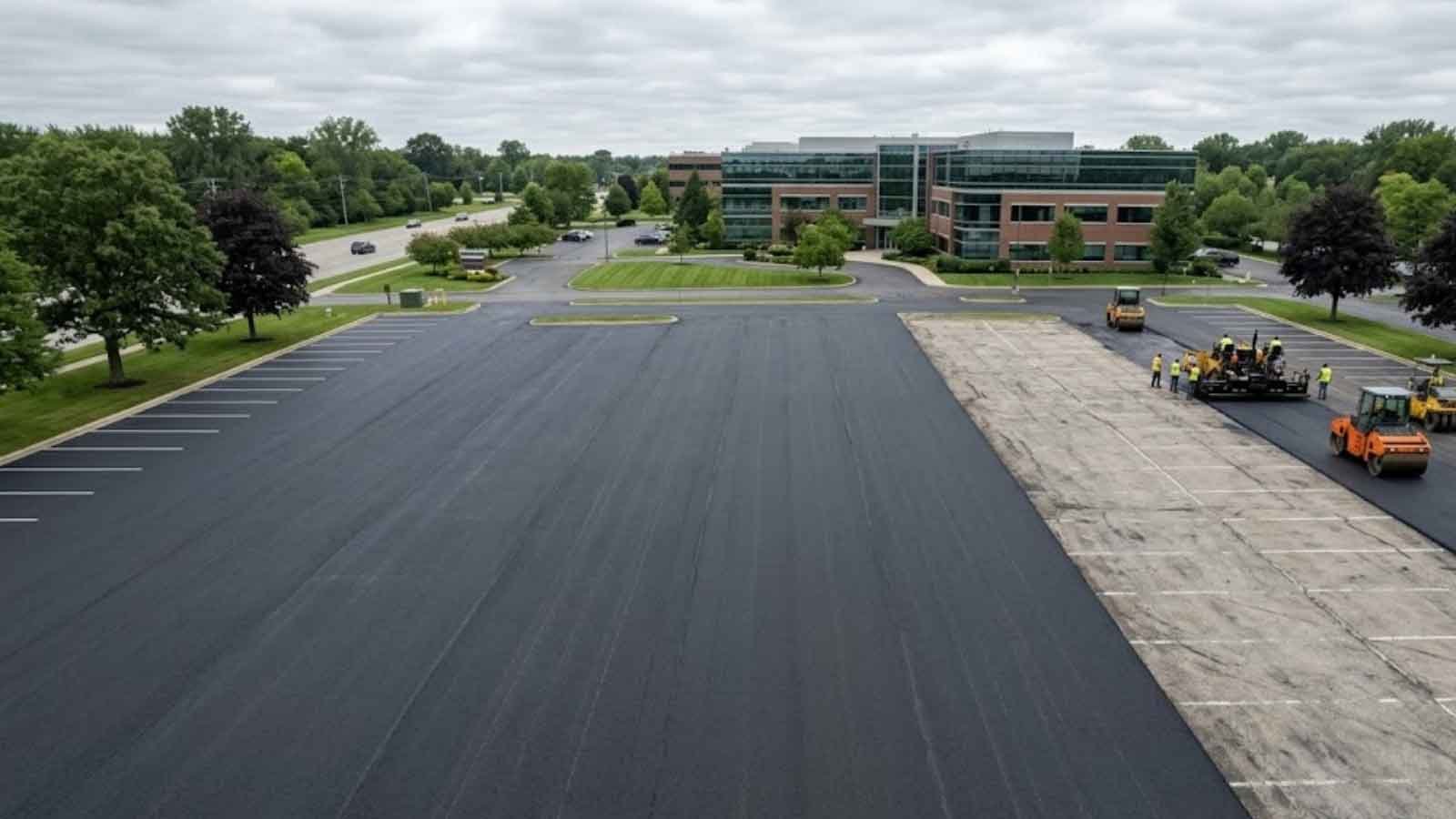
Asphalt parking lot repaving in Southern California currently runs $3 to $5 per square foot for a 2-inch overlay and $5 to $8 per square foot for a 4-inch full removal and replacement. These figures cover materials only, exclude labor, reflect current 2026 California rates, and shift with crude oil prices.
Where bids land within and across these ranges depends almost entirely on scope. The word "repaving" is used loosely across the industry, and three different contractors may quote three very different jobs under the same term. This article covers the three scopes a commercial buyer typically chooses between, current Southern California material pricing for each, the factors that move quotes, and what to look for when reading a bid.
Current Pricing for Southern California Commercial Lots
Material pricing below reflects current 2026 California rates, excludes labor, and is subject to change as crude oil prices fluctuate. Asphalt binder is a petroleum product, so quotes shift with the oil market, which is why fixed all-in pricing is rarely published online.
Materials Pricing by Scope
- Overlay (2" resurfacing): approximately $3 to $5 per square foot in materials
- Mill-and-overlay: materials priced between overlay and full removal, depending on milling depth and base repair scope
- Full removal and replacement (4"): approximately $5 to $8 per square foot in materials
Labor is additional and varies with team size, project duration, traffic phasing, and site conditions. The per-square-foot ranges above are for reference only and may change with raw material costs.
Overlay, Mill-and-Overlay, or Full Replacement: Which One Does Your Lot Need
Most commercial lots end up in one of these three scopes. Each describes a different job at a different price, and "repaving" gets applied to all three in everyday usage. Choosing correctly is the foundation of an accurate budget.
Overlay (Resurfacing)
An overlay places new asphalt over the existing surface after cleaning, crack treatment, and minor surface preparation. No old asphalt is removed. Common commercial overlay thickness runs 1.5 to 2.5 inches, depending on lot use, traffic volume, vehicle weight, and existing pavement profile.
Overlay is appropriate when:
- The base and subgrade are structurally sound
- Damage is surface-level (oxidation, light cracking, minor rutting)
- The lot drains correctly
- Door thresholds, curbs, and ADA transitions can accommodate the added height
Overlay is the lowest-cost option. With proper maintenance, a commercial overlay typically delivers 8 to 15 years of service life. Placing new asphalt over a failed base reproduces the failure on a new surface within a few seasons.
Read More: Is It Better to Resurface or Replace Your Parking Lot?
Mill-and-Overlay
This is the scope most commercial buyers are actually pricing when they ask about the cost of commercial parking lot paving. The top inch or two of existing asphalt is ground and milled off, areas of base failure are repaired locally, and a new asphalt lift is placed at a controlled thickness.
Mill-and-overlay matters because:
- It maintains existing grades, drainage patterns, and curb heights
- It removes oxidized, cracked surface material before the new lift is placed
- It allows targeted base repair without full excavation
- It avoids height-transition problems that an overlay creates at doors, drains, and ADA ramps
If a contractor proposes a straight overlay on a lot with localized base failure, mill-and-overlay is often the more durable middle option.
Full Removal and Replacement
Full removal and replacement removes the existing pavement structure and rebuilds it from the ground up. Existing asphalt and often the base material are removed, subgrade issues are corrected, and a new pavement structure is installed. This is the right call when:
- The subgrade has failed
- Water pools after rain across significant areas
- Repeated patches keep failing in the same locations
- The original construction was undersized for the actual traffic load
This is the most expensive scope and the only option when the structure itself has failed. With proper maintenance, full removal and replacement typically delivers 20 to 30 years of service life, roughly double an overlay's expected lifespan.
Signs the Lot May Need More Than an Overlay
These indicators often suggest deeper structural issues, and a pavement evaluation is usually the right next step before committing to a scope:
- Water pooling after rain
- Patches that crack open again within a year
- Alligator-pattern cracking across large areas
- Potholes that are returning in the same locations after repair
- Visible base material at crack edges
None of these is diagnostic on its own. They are signals to request an on-site evaluation, not to assume full replacement.
What Drives Cost Within Any Scope
Once the scope is settled, several variables determine where pricing actually lands.
Existing Pavement Condition
A well-maintained aged lot sells for more than a neglected one of the same size. Base repair work needed before the new asphalt is placed adds materially to costs. Localized base repair is usually priced separately by tonnage, square yard, or failed-area percentage rather than as a uniform add-on rate, which is why repair line items can vary between contractors evaluating the same lot.
Asphalt Thickness Specification
Compacted thickness is one of the largest single cost drivers and one of the most commonly missed line items in bid comparisons. Common specifications include:
- 2 inches: light-duty parking areas only
- 3 inches: typical retail and office lots
- 4 inches or more: warehouse, industrial, and fire-lane traffic
- Multi-lift structures (leveling course plus surface course) for heavier-duty applications
Always confirm the specified compacted thickness when evaluating a quote.
Traffic Load and Use Type
Pavement thickness, base depth, and material specification all shift with the actual load:
- Retail and office: lighter traffic, standard specifications
- Warehouse and distribution: truck loading zones need additional thickness and base
- Dumpster pads: typically over-specified or done in concrete because of point loading and turning
- Fire lanes: specific load and access requirements set by code
- Industrial sites: often require engineered pavement sections
The same square footage can carry significantly different costs based on what drives across it.
Site Conditions
- Truck access and haul distance affect delivery and disposal costs
- Drainage corrections can add modestly to substantially, depending on the scope. Catch basin reconstruction, trench drains, underground pipe correction, or ADA regrading can move drainage line items well into five figures
- Irregular shapes, islands, and tight access points add equipment hours
Regional Labor, Permits, and Code
Crew time ranges from 2 to 3 days for lots under 20,000 square feet and 3 to 5 days for sites between 20,000 and 60,000 square feet. Permits and traffic control plans vary by jurisdiction. Empire Parking Lot Services works across Orange, Los Angeles, Riverside, and San Bernardino counties, and each county carries its own permit, code, and inspection requirements.
ADA Compliance Work
ADA compliance is broader than accessible stall striping. A complete ADA scope can include:
- Accessible route slope and cross-slope compliance
- Curb ramp construction or repair
- Detectable warning surfaces at transitions
- Stall and aisle dimension corrections
- Signage at correct mounting heights
- Van-accessible stall configurations
When existing pavement is being replaced or significantly altered, ADA upgrades for the affected areas often have to be brought up to current code. This can be a major addition to the scope.
Striping, Curbing, and Site Markings
After any repaving scope, the surface needs to be re-marked. Parking lot striping is typically priced per linear foot or per stall, with ADA markings, arrows, crosswalks, and curb painting line-itemed separately. Many bids exclude striping by default, so it should be confirmed line by line.
Asphalt vs. Concrete: A Brief Comparison
Property managers sometimes use a repaving decision as a moment to compare asphalt and concrete. Short version:
- Asphalt: lower upfront cost, faster installation, easier to repair, 8 to 30 years of service life depending on scope, requires periodic sealcoating and crack maintenance
- Concrete: higher upfront cost, longer cure time, harder to repair locally, longer lifespan in the right conditions, less ongoing maintenance
For most commercial parking applications in Southern California, asphalt remains the standard. Concrete tends to perform well in high-load areas such as dumpster pads, drive-through lanes, and loading zones.
How to Read a Repaving Bid
Bids vary because scopes vary. Putting them on equal footing means confirming every line. A lower total does not always mean a better price. It often means something was left out.
What a Complete Bid Should Specify
- Exact square footage being addressed. The measured area should match across every bid you compare. If one contractor quotes 45,000 square feet and another quotes 38,000, they are not pricing the same job.
- Scope: overlay, mill-and-overlay, or full removal and replacement. This is the single largest cost variable. A bid that says "repaving" without specifying which scope leaves you comparing unlike work at unlike prices.
- Milling depth, if applicable. Mill-and-overlay projects should state how many inches of existing asphalt will be removed. Milling depth affects material cost, disposal volume, and how well the new lift bonds to the surface below.
- Compacted asphalt thickness that’s being installed. A bid quoting 2 inches and a bid quoting 3 inches are not the same job, even if they have identical square footage. Confirm the specified thickness is a compacted measurement, not loose.
- Lift structure (single or multi-lift). Heavier-traffic applications may require a leveling course followed by a surface course rather than a single lift. Multi-lift structures cost more and perform better under truck and loading-dock traffic.
- Base preparation and any localized subgrade or aggregate base repair, with a method of measurement. This is where bids diverge the most. One contractor may include 500 square feet of base repair; another may exclude it entirely and bill it as a change order once the surface is removed. Confirm how failed areas are identified, measured, and priced.
- Disposal of old material. Removal and replacement projects generate haul-off volume. The bid should state who handles disposal and at what cost. All asphalt removed by Empire is recycled at the plant, and roughly 40% of new asphalt installed contains recycled materials.
- Striping, with stall count and marking detail. Many bids exclude striping by default. Confirm that the stall count, ADA-compliant markings, arrows, crosswalks, fire lane markings, and curb painting are itemized separately. Striping is required after any repaving scope; if it is missing, the bid is incomplete.
- Drainage work scope, if any. Catch basin reconstruction, trench drains, grade corrections, and underground pipe work each carry their own cost. If the lot has standing water issues, drainage corrections should be spelled out as a separate line item rather than folded into a lump sum.
- ADA scope, if any. Repaving that alters pavement grade can trigger ADA upgrade requirements under California Title 24. Confirm the bid addresses accessible route slopes, curb ramp construction, truncated dome installation, signage, and, if applicable, van-accessible stall configurations.
- Warranty terms. What is covered, for how long, and under what conditions. A warranty that excludes normal wear, weather damage, or base-related issues may not cover much in practice.
- Permit handling. Empire can handle permits, but permit work incurs an additional cost that should be included in the bid. Some jurisdictions require traffic control plans, inspections, or specific code compliance steps that vary by county.
- Project timeline and traffic phasing. The bid should state the start date, estimated completion, and how the work is phased on active properties. Empire's production team provides a phasing plan so property managers can visualize each stage and communicate timing to tenants and customers.
Comparing two bids fairly means confirming both cover the same scope, thickness, and prep work. A low number on an incomplete bid is not a savings; it is an unpriced surprise waiting until the job starts.
Read More: Navigating Overbudget Costs in Paving Projects: A Guide for Orange County Contractors
Measuring Your Lot
Knowing your square footage lets you compare per-unit pricing accurately:
- Rectangular lots: length multiplied by width
- Irregular lots: aerial measurement tools or Google Earth's measure feature
Include a measured area in every bid request so contractors quote against the same area.
Repaving as a Long-Term Investment
The right scope at the right time delivers a long service life. Overlays typically deliver 8 to 15 years with proper maintenance. Full removal and replacement typically delivers 20 to 25 years under the same conditions. Actual lifespan varies with climate, traffic load, drainage, subgrade quality, asphalt mix, and maintenance history.
Maintenance practices that preserve lifespan across both scopes:
- Sealcoating every 3 to 5 years: protects against UV, water, and oxidation
- Crack sealing as cracks appear: keeps water out of the subgrade, where it does the most damage
- Regular inspection and sweeping: catches problems early, when repairs are still inexpensive
Lots that receive this care reach the upper end of their expected range. Lots that do not, generally do not.
Get an Accurate Number for Your Property
Every lot's condition, drainage, subgrade, traffic load, and ADA status is different, and no honest estimate can be produced from a square-footage figure alone. Empire Parking Lot Services provides free estimates based on a pre-production site walk with your estimator and production manager, so the bid reflects your actual lot conditions.
Our proposals are valid for 30 days from the date of issue. Pricing accepted within that window is locked in for the project regardless of market shifts during execution.
We have served Orange County, Los Angeles County, Riverside County, and San Bernardino County since 2008, operating under CSLB license #1098884. Experienced foremen oversee every project. End-of-project photo and video documentation are provided upon request. On every job, our team communicates where, when, and how long so you and your tenants know what to expect at each phase.
Contact Empire Parking Lot Services or request a quote to schedule a site walk and get an estimate for your property.


Comments