
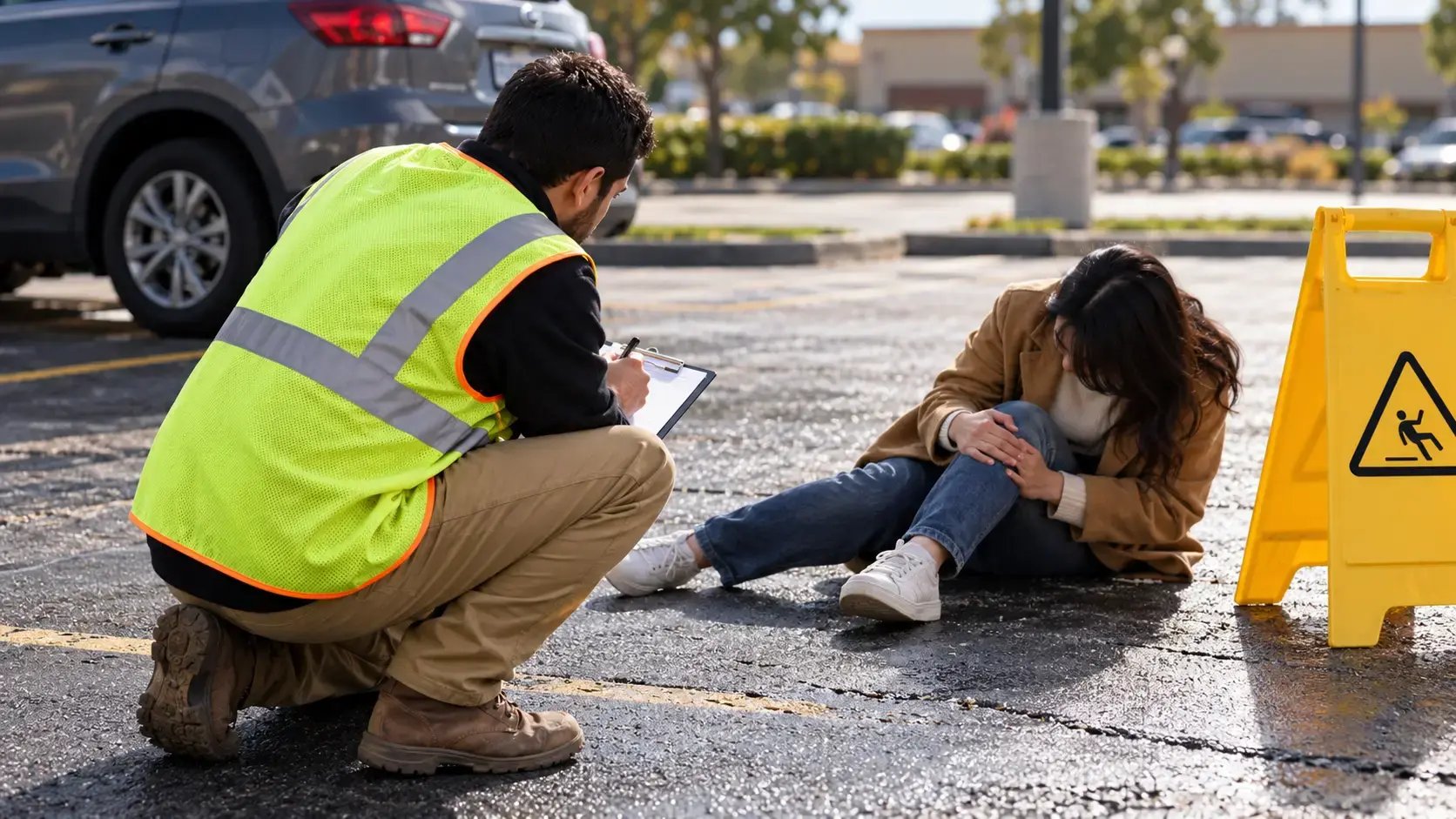
Yes, a property owner or manager can be held liable for a parking lot injury when it traces back to a hazard they knew about, or should have found, and did not repair or warn people about. The strongest protection is a documented program of parking lot maintenance services that catches hazards before they become a claim.
A pothole that sat in the drive aisle for four months is not bad luck. It is a record of what the owner knew and when. After an injury, the property is measured against how a reasonable owner would have managed it, and the maintenance file is usually what answers that question first.
How Do You Know Who Is Responsible for a Parking Lot Injury?
Responsibility follows control. California Civil Code Section 1714 makes everyone responsible for injuries caused by a lack of ordinary care in managing their property, and in a parking lot that duty belongs to whoever controls the pavement.
- Single-tenant property: usually the owner, unless the lease shifts maintenance to the tenant
- Multi-tenant retail or office: usually the landlord or property manager, who controls the common areas
- HOA community: the association, for common-area drive aisles and guest parking
- Shared lot: split according to the recorded agreement between the parcels
The lease or CC&Rs decide most of this, and an attorney should confirm how they apply to a specific property. California also uses comparative fault, so a visitor who was not watching where they walked may carry part of the responsibility. That reduces exposure. It does not erase it.
When Does a Parking Lot Hazard Become a Liability?
A hazard becomes a liability when the owner had notice. Actual notice means someone reported it. Constructive notice means it existed long enough that a reasonable inspection would have caught it.
The second category is where most owners get caught. A raised sidewalk edge or a pothole that opened after the winter rains does not need a complaint on file. If it was visible for weeks, the owner can be treated as if they knew.
Southern California conditions speed this up. UV exposure and heat cycles open cracks, and the first storms after a dry summer push water straight into them. Knowing what causes asphalt to deteriorate explains why a lot that looked fine in spring can have new defects by January.
What Parking Lot Hazards Lead to Injury Claims?
Parking lot injuries come from two directions: people slipping or tripping on the surface, and vehicles moving through spaces where people walk. The conditions behind both are predictable, which is why they count against an owner who ignores them.
Potholes, Cracks, and Uneven Asphalt
Potholes and lifted pavement edges are the classic trip hazard, and they grow quickly once water reaches the subgrade. Sealing cracks before they develop into potholes is the earlier, lower-cost fix, and professional asphalt crack sealing closes the path water takes.
Patching typically runs $150 to $500 per pothole. These figures reflect 2026 California material costs, exclude labor, and are subject to change as crude oil prices fluctuate. Holes that have formed in walking paths need scheduled asphalt repair before they become a documented hazard.
Faded Striping and Missing Markings
Faded crosswalks, stop bars, and directional arrows leave drivers guessing where pedestrians will cross. Striping typically lasts about 2 years depending on traffic and conditions, so a lot striped three years ago may already be overdue. Scheduled parking lot striping keeps crosswalks, fire lanes, and traffic flow readable.
Sidewalk Trip Hazards and Accessible Routes
Raised concrete slabs at walkways and curb transitions catch visitors who are watching for cars, not their feet. Concrete sidewalk repair levels those slabs and removes the edge.
Accessible routes carry their own standard. Truncated domes, the rows of raised, flat-topped bumps at curb ramps, give pedestrians who are blind or have low vision a warning they can feel before stepping into vehicle traffic. California requires them under Chapter 11 of the California Building Code at curb ramps and in pedestrian areas that meet vehicle travel without a curb. The dome surface must measure at least 3 feet in the direction of travel and contrast visually with the pavement around it.
Worn ramps, faded accessible stall markings, and missing domes tend to show up together. The stall side of that route is covered in how many handicap parking spaces are required in California. A Certified Access Specialist (CASp) report identifies which elements no longer meet current standards. Empire Parking Lot Services can address the confirmed deficiencies through its ADA upgrades once the report is in hand.
Missing domes do not always mean a new ramp. Empire Parking Lot Services installs Safety Step truncated dome mats, which bond to existing concrete or asphalt through a thin fiberlath base. Ramps with slope or surface problems go through handicapped ramp construction, and handicap striping services restore the stall markings on the same schedule.
Vehicles Leaving the Drive Aisle
Storefronts that face head-in parking carry a risk that has nothing to do with pavement: a driver who hits the gas instead of the brake. Recent cases have treated those crashes as foreseeable, and what the $91M 7-Eleven case means for property owners shows how that reasoning played out. Professional sign and bollard installation puts a physical barrier at the entrance.
How Can Property Owners Reduce Parking Lot Liability?
Find hazards first, and keep a record that you did. A defensible program has three parts:
- A scheduled inspection at least once a year, plus a walk after the first heavy rain of the season, covering cracks, potholes, raised edges, striping, signage, and drainage
- Repairs ranked by risk, starting with the walkways and drive aisles that carry the most foot traffic
- Documentation: dated photos, the work order, and the completion date for every repair
The documentation is what turns maintenance into evidence. An owner who can show a hazard was repaired within days of being found is in a far stronger position than one relying on memory. Traffic cones and a posted caution sign matter while a repair is pending, because a marked hazard is judged differently than an unmarked one.
Request a Parking Lot Safety Assessment in Orange County
Retail, office, industrial, multifamily, and HOA properties across Orange, Los Angeles, Riverside, and San Bernardino counties work with Empire Parking Lot Services to find hazards before visitors do. We tell owners plainly what needs attention now, what can wait, and what does not need work at all.
Every project starts with a pre-production site walk with the customer, estimator, and production manager. Experienced foremen oversee the work, and our team tells you where, when, and how long before each phase. End-of-project photos and videos are available on request, which gives you the dated record that matters most if an incident is ever questioned. We have served Southern California since 2008 under CSLB license #1098884.
Request an assessment for parking lot maintenance on your property, or call 877.760.2757.
FAQs
Does a “park at your own risk” sign protect a property owner from injury claims?
Not from hazards the owner should have fixed. It does not replace the duty to keep pavement and walkways in reasonably safe condition. An attorney can confirm how it applies to a specific property.
Is the landlord or the tenant liable for a parking lot injury?
Generally, whoever controls the area bears the duty. Common areas in multi-tenant properties usually fall to the landlord; single-tenant leases often shift that responsibility. A lease review with an attorney settles the question for any specific property.
How often should a commercial parking lot be inspected for hazards?
At least once a year, plus a walk after the first heavy rain each season, when new potholes and cracks tend to appear.
Does sealcoating reduce parking lot liability?
Indirectly. Sealcoating every 3 to 5 years slows the oxidation and water intrusion that create cracks and potholes, so fewer trip hazards form between inspections.
Can an injured visitor be partly at fault in California?
Yes. California uses comparative fault, so damages can be reduced by the visitor’s own share of responsibility, such as walking while looking at a phone. The owner’s share remains.
What documentation should a property owner keep after making a parking lot repair?
Dated before-and-after photos, the work order with the contractor’s CSLB license number, and the completion date. Together, those records establish that the hazard was found and addressed promptly. That is the difference between a defensible position and an exposed one.
What is constructive notice in a parking lot injury case?
Constructive notice means a hazard existed long enough that a reasonable inspection would have caught it. An owner does not need to receive a formal complaint for a court to treat them as if they knew the defect was there.


Comments