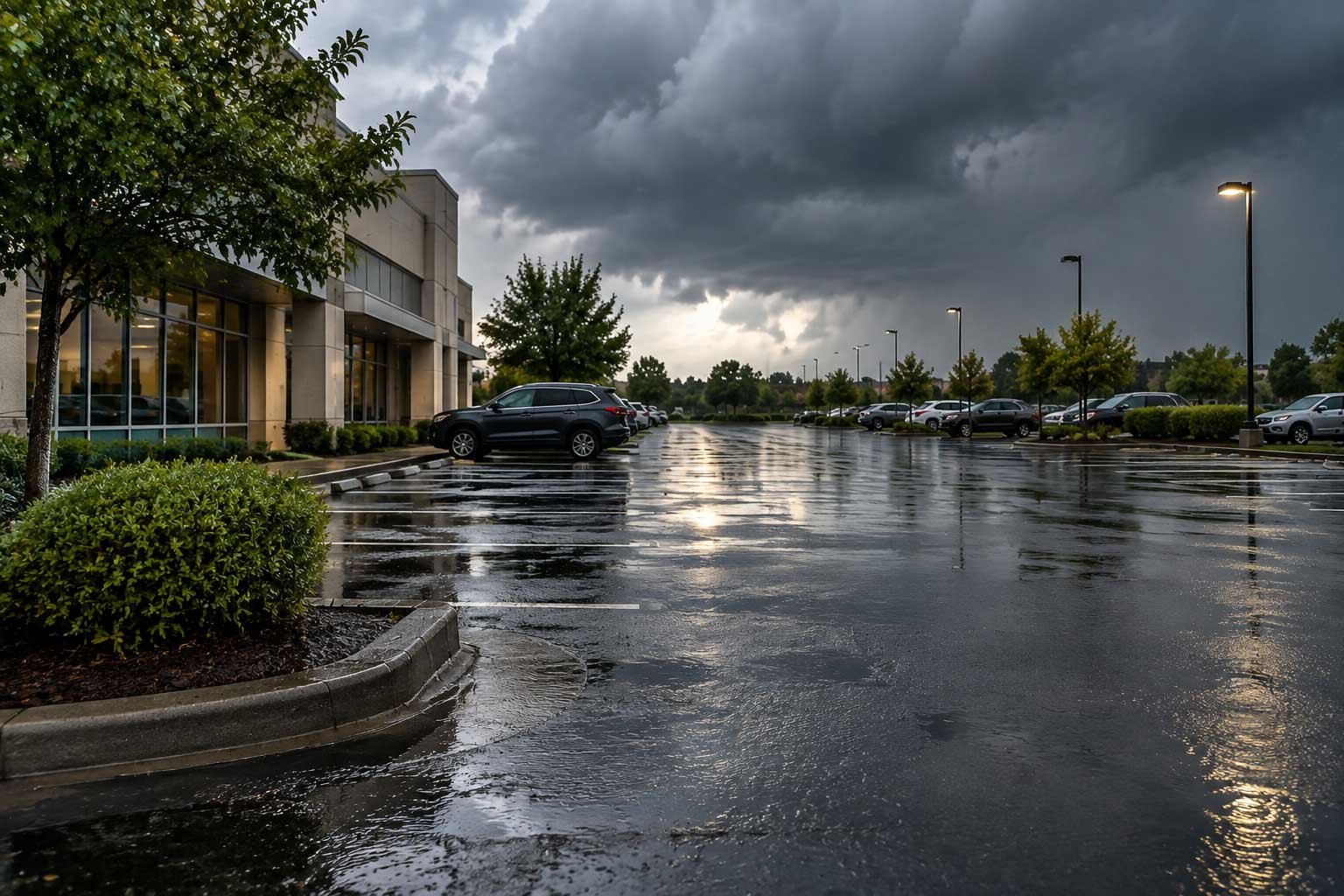
NOAA's Climate Prediction Center upgraded its El Niño outlook to an Advisory in June 2026. NOAA now puts the odds of a very strong event at 63 percent, a sharp increase from the roughly 1-in-4 chance flagged earlier this year. For property managers across Orange County and the rest of Southern California, that forecast comes with a deadline.
The way to protect your parking lot before El Niño storms arrive is to seal every open crack, patch every pothole, correct the low spots that hold water, and apply sealcoating while the pavement is still dry and warm. Each of those steps depends on a weather window that closes once the rainy season starts, so the work belongs on the calendar now, not in December.
Why Does El Niño Put Southern California Parking Lots at Risk?
Asphalt handles a normal winter without much trouble. An El Niño winter is different because the rain arrives in long, saturating events with short dry gaps in between, and that pattern attacks pavement at its weakest point: the aggregate base underneath.
Here is the sequence that turns a small defect into a closed drive aisle:
- Rain enters through unsealed cracks, open joints, and the edges of existing potholes.
- Water saturates the aggregate base, which loses the stiffness that supports the overlying asphalt.
- Vehicle tires press down on the softened base, pumping trapped water back up through the surface.
- The asphalt flexes, cracks spread, and potholes open within days instead of months.
The 1997-98 and 2015-16 El Niño winters both produced widespread pothole damage across the region, and the lots that came through in the best shape were the ones already on a consistent parking lot maintenance program going into the season.
The difference comes down to drainage. A lot with sealed cracks and working drainage sheds water. A lot with open defects absorbs it, and absorption is what breaks the base.
When Should Parking Lot Repairs Be Done Before the Rainy Season?
The practical window for pre-storm work in Southern California runs through October into early November. After that, shorter days, cooler pavement, and the first storm systems make several key treatments unreliable.
Each treatment has its own weather requirement:
- Sealcoating needs dry pavement, surface temperatures above 50°F, and a rain-free stretch afterward to cure. Any rainfall during that cure window compromises adhesion and leaves the surface unprotected.
- Crack sealing requires a clean, dry crack channel. Moisture trapped beneath the sealant breaks the bond, causing the crack to reopen.
- Water-based traffic paint needs a dry surface. Empire Parking Lot Services can stripe on a dried sealcoat the same day, weather permitting, which is one more reason fall scheduling matters.
- Grading and patching work needs dry base material to compact properly.
Timing matters for tenants as much as for materials. Fall lets you sequence work in phases and keep most of the lot open. Emergency asphalt repair in January usually means barricades, unplanned closures, and a temporary patch that has to be redone in spring. Booking parking lot striping and sealcoating in one fall visit closes out the season with fresh markings and a protected surface at the same time.
What Repairs Protect a Parking Lot Before Heavy Rain?
Pre-storm work follows an order. Repairs that close entry points come first, treatments that shed water come second, and anything applied out of sequence wastes both material and time.
Crack Sealing Comes First
Every crack wider than a quarter inch is a direct channel to the base. Hot-applied crack sealing fills that channel with a flexible material that moves with the pavement through winter temperature swings. It is the most effective single pre-storm treatment, and it must go down before sealcoating because sealcoating alone will not bridge an open crack.
Pothole and Patch Repairs Close Open Entry Points
A pothole is a base failure that has already reached the surface, and rain widens it with every storm. Pothole repair on a pre-storm schedule means cutting the damaged section back to sound asphalt, removing wet or loose base material, and compacting new hot mix in place. A skin patch troweled over the hole holds for weeks. A full-depth patch holds for years.
Grading and Drainage Corrections Stop Ponding
Standing water after a light rain marks the spots where the base has already settled. Correcting parking lot drainage on the pavement side means grinding or patching those depressions to restore the fall toward the drains, so water leaves the surface rather than sitting on it. Ponding areas left alone become the first potholes of the season.
Sealcoating Adds a Surface Barrier
Once cracks and potholes are closed, sealcoating gives the whole surface a water-resistant layer that also slows UV oxidation. It protects sound pavement and does not repair damaged pavement. Empire Parking Lot Services applies it on a three-to-five-year cycle, and any lot at or past that interval should get the application done before the first storm rather than after.
Curb and Gutter Repairs Direct Runoff
Concrete curbs and gutters control where water goes once it leaves the asphalt. A cracked gutter or displaced curb directs runoff along the pavement edge, the thinnest and least supported part of any lot. Repairing those sections in the fall keeps water moving toward the catch basins where it belongs.
Overlay or Resurfacing for Pavement Past Repair
Some lots carry too much alligator cracking or too many failed patches for sealing to make sense. In those cases, the honest recommendation is to hold the sealcoat and plan an overlay or full resurfacing. If the timeline allows, schedule it before storm season. If not, it can wait for a confirmed dry window in spring. Empire Parking Lot Services would rather recommend the right fix than apply a treatment that cannot save the surface.
What Should Property Managers Check After the First Storm?
The first heavy rain is a free inspection. Walk the lot within a day of the storm and again after it dries, because the two views reveal different problems.
While the surface is still wet, look for:
- Pools that remain more than a few hours after the rain stops
- Water running across drive aisles instead of toward the drains
- Clogged catch basin grates and blocked gutter lines
Once the surface dries, look for:
- New hairline cracks near existing patches
- Raveling or loose aggregate along the pavement edges
- Heaved or shifted concrete at ramps and walkways
That last item carries a compliance exposure in addition to the maintenance one. Displaced ramps, cracked landings, and lifted truncated domes can push an accessible route out of tolerance, and storm damage does not pause a property's accessibility obligations. Schedule ADA upgrades alongside any concrete repair before the next front arrives.
Schedule a Pre-Storm Inspection with Empire Parking Lot Services
Empire Parking Lot Services has served commercial properties in Orange, Los Angeles, Riverside, and San Bernardino counties since 2008. Every project begins with a pre-production site walk where you, the estimator, and the production manager review the lot together and agree on what needs to happen before the rain. Before each phase, you receive a clear commitment on where, when, and how long, so tenants know what to expect. Experienced foremen oversee the work on site, and you receive end-of-project photos and videos documenting the finished result.
Call 877.760.2757 or request a free estimate to get your lot on the fall schedule. Empire Parking Lot Services holds CSLB License #1098884.
FAQs
Is El Niño confirmed for the 2026-27 winter?
Yes. NOAA's Climate Prediction Center issued an El Niño Advisory in June 2026 and forecasts strengthening conditions through winter, with a 63 percent chance of a very strong event.
Can sealcoating be applied during the rainy season?
Not reliably. Sealcoating requires surface temperatures above 50°F and a 24- to 48-hour window without rain after application. Empire Parking Lot Services schedules it in the fall, before storm season, or waits for a confirmed dry window in the spring.
Does sealcoating fix cracks and potholes?
No. It protects sound pavement, and open cracks and potholes must be sealed or patched before it goes down.
How soon can a lot be striped after sealcoating?
Empire Parking Lot Services can stripe the same day on a dried sealcoat when weather allows. Water-based traffic paint is used for all outdoor parking lot striping.
What if my lot has too much damage to seal?
Sealing badly damaged pavement wastes the treatment. Either overlay or full resurfacing is the appropriate path, and Empire Parking Lot Services will indicate which during the site walk.
Can El Niño storms create ADA compliance problems?
Yes. Rain can shift ramp landings, crack truncated-dome surfaces, and displace curb transitions enough to push an accessible route out of ADA compliance. Storm damage does not suspend compliance obligations, so inspection after every major front is the right practice.
How long do pre-storm repairs take to complete?
Most lots under 20,000 square feet take two to three days. Lots between 20,000 and 60,000 square feet take three to five days.


Comments