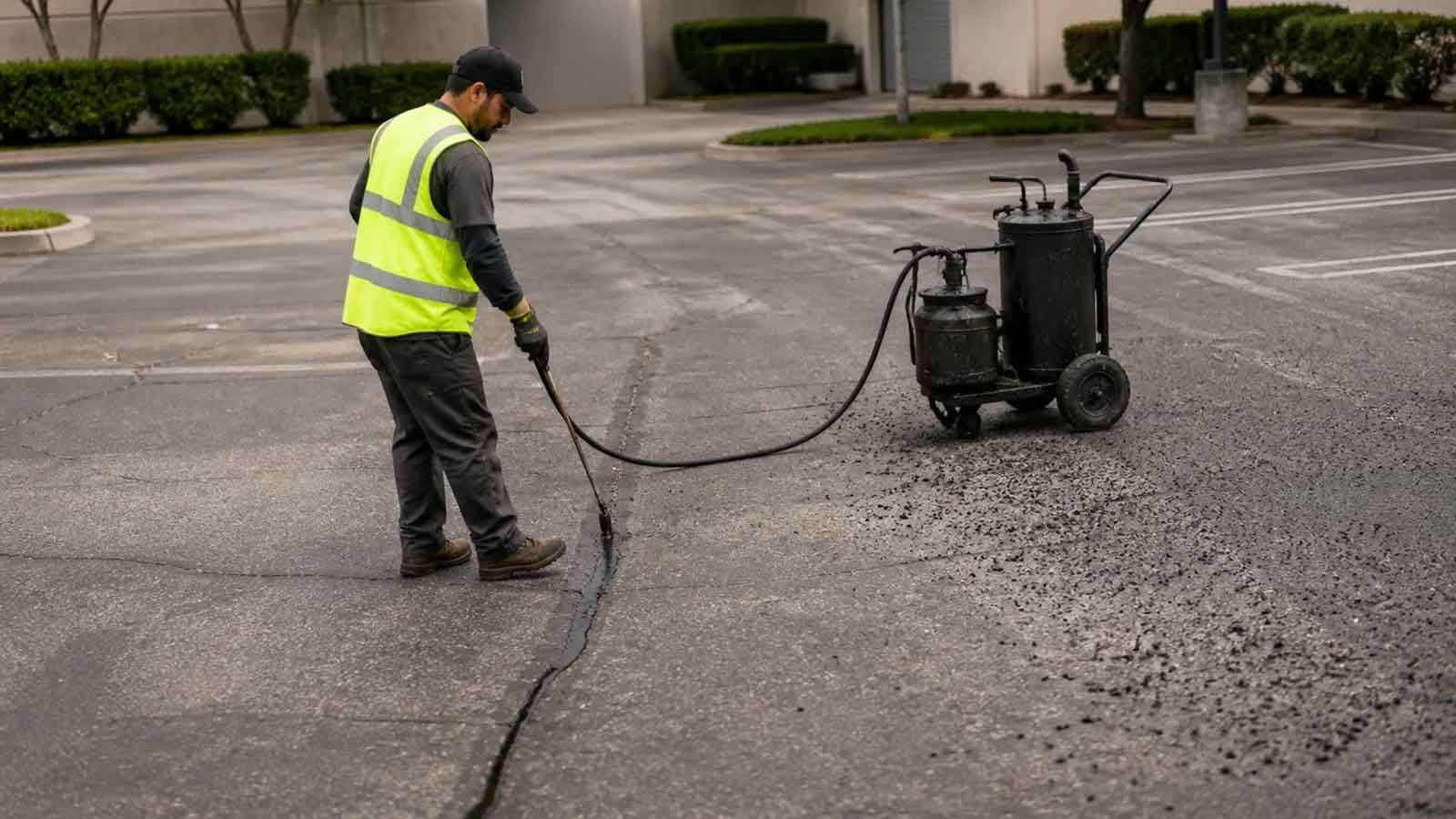
Crack sealing and crack repair are two different services, and choosing the wrong one means spending money on a service that does not address the actual problem. Sealing keeps water out of narrow surface cracks in pavement that is still sound. Repair removes and replaces asphalt where the cracking signals failure in the base underneath.
Getting the right treatment on the right crack, at the right time, is what separates an Orange County lot that lasts from one that needs full replacement years early.
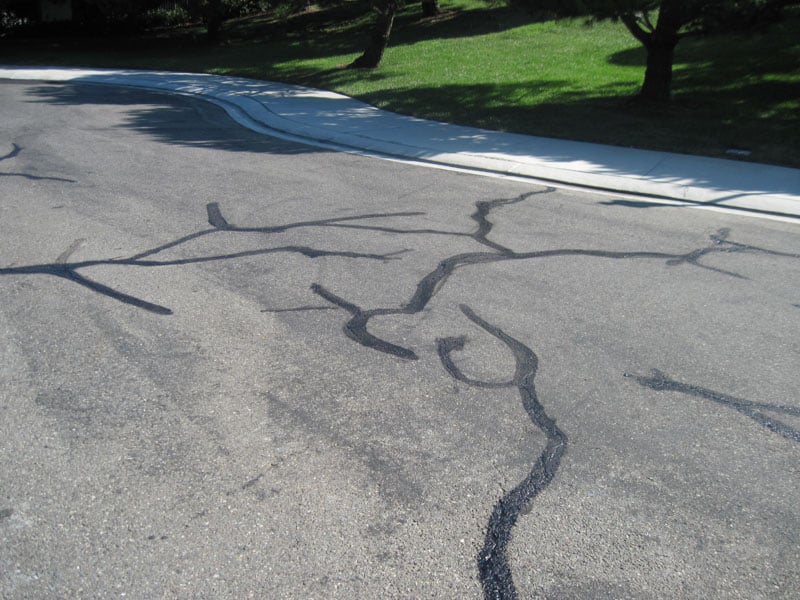
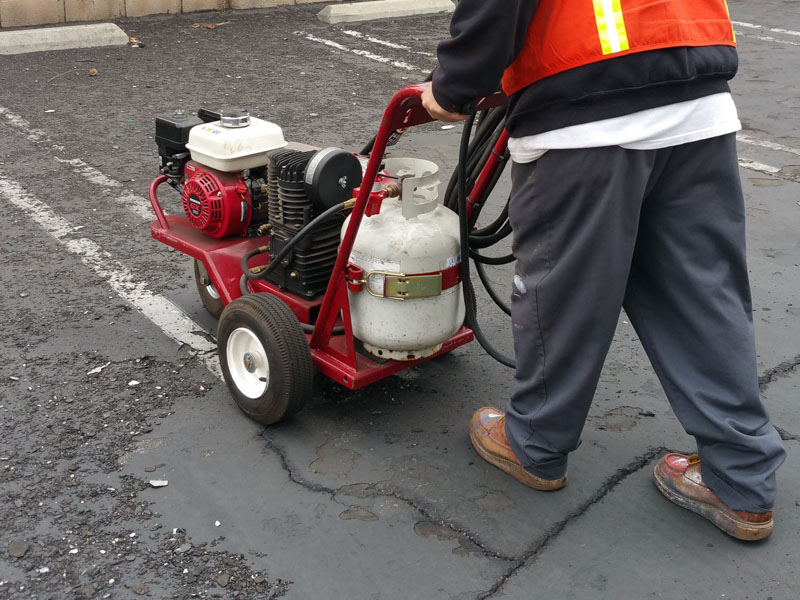
Crack sealing places hot rubberized sealant into active surface cracks, preventing water from reaching the subgrade. Crack repair, also called partial-depth asphalt repair, cuts out and replaces the asphalt where the base has already shifted or become saturated, and sealant on top would do nothing to address the failure underneath.
Sealing applies to cracks under 1/2 inch wide in a lot whose structural foundation still holds. The pavement just needs help keeping water out. Non-working cracks that do not open and close with temperature can be crack-filled with asphalt emulsion instead.
Neither crack filling nor sealcoating replaces crack sealing. Sealcoating coats the surface but does not bridge open cracks, so crack sealing must come first. Cracks that no longer fit the description above have crossed into repair territory.
Alligator cracking, cracks wider than 1/2 inch, failed pavement edges, and pothole-adjacent distress all point to subgrade failure. Sealant will not restore that structure. These areas need partial-depth repair and, in advanced cases, a full-depth removal and replacement.
If you are not sure which category your cracks fall into, this guide to diagnosing structural vs. cosmetic cracks can help narrow it down before the site visit. A rough sense of crack width and pattern speeds up the inspection and sets expectations for cost.
Seal when the crack is narrow, the surrounding asphalt is intact, and the base is sound. Repair when the crack is wide, spreading, or part of an interconnected pattern.
The call is made on-site, not over the phone. Crack width, movement, deterioration of the surrounding asphalt, and the condition of the base all factor in. Many Orange County lots need a mix: sealing across most of the surface and partial-depth repair in the sections where the base has failed.
Timing matters as much as method. Long dry stretches and sun-driven oxidation open cracks through summer, and the Orange County rainy season sends water straight through them. Sealing in early fall closes those cracks before the water arrives. Sections that already show base failure should be moved to scheduled asphalt repair instead. Which side of that line each section falls on also determines the cost.
Crack sealing runs $0.50 to $2.00 per linear foot. That range excludes labor, reflects 2026 California pricing, and changes as crude oil prices fluctuate. It is a planning range, not a quote, and partial-depth repair is priced separately after the site walk because the cost depends on how much pavement needs to be removed. What moves a project within its range:
Sealing before the rainy season is the financially sound move, since open cracks left through winter let water reach the subgrade and turn a sealing job into a repair job. Bundling crack sealing into scheduled parking lot maintenance services keeps that from becoming an annual surprise.
Crack seal lifespan varies by traffic volume, sun exposure, crack preparation quality, and how much the pavement continues to move, and those factors play out differently on every lot.
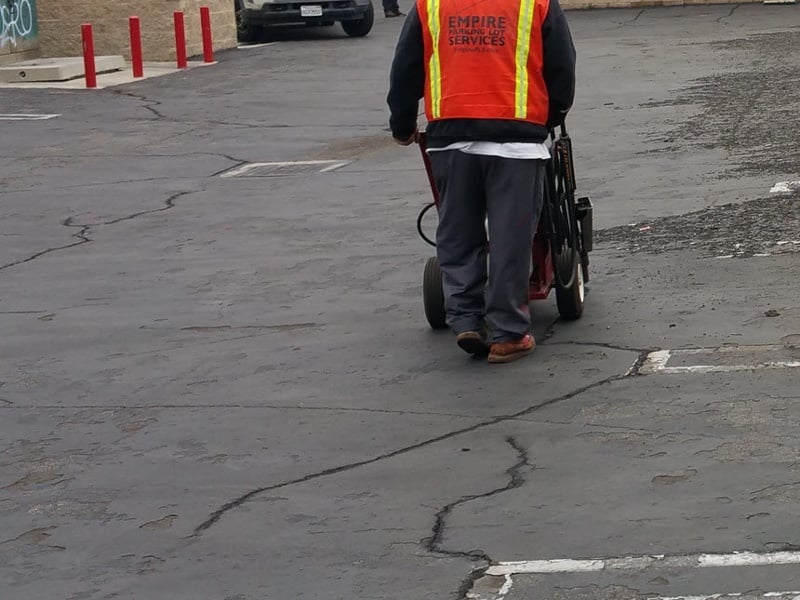
Preparation is the biggest variable, and it is the one the contractor controls. Sealant that bonds to debris or moisture, rather than to sound asphalt, fails within a season. Every job follows the same sequence:
Cure time depends on weather, temperature, and material, so no fixed window applies to every job. Once the seal has set, the next step is to apply sealcoat to protect the surrounding surface. Crack sealing always comes first.
Empire Parking Lot Services works with retail, office, industrial, warehouse, distribution, and multifamily or HOA properties across Orange County, including Orange, Anaheim, Irvine, Santa Ana, Tustin, and Costa Mesa, with additional coverage in Los Angeles, Riverside, and San Bernardino counties.
Every project starts with a pre-production site walk with the customer, estimator, and production manager, where the seal-or-repair call is made. Experienced foremen oversee the work. Our team monitors the weather weekly so rainy-season scheduling stays realistic, and you always know where, when, and how long before each phase. End-of-project photos and videos are available on request.
We have served Southern California since 2008 under CSLB license #1098884. Request a free estimate for asphalt crack sealing and repair before the rainy season arrives.
No. Sealcoating protects the surface from sun and chemical exposure but does not fill or bridge an open crack. A sealcoat applied over untreated cracks hides them without stopping the deterioration underneath.
Cracks under 1/2 inch wide in pavement with a sound base are candidates for sealing. Wider cracks, or cracks running through visibly deteriorated asphalt, usually need partial-depth repair.
Alligator cracking is a pattern of interconnected cracks that signals subgrade failure. Sealant alone will not fix it; that damage needs partial-depth repair or a larger scope, not surface treatment.
There is no fixed lifespan. It depends on traffic volume, sun exposure, how well the crack was cleaned and prepared, and how much the pavement continues to move afterward.
Open cracks let water reach the subgrade during the Orange County rainy season, and water in the base is what turns a small sealing job into a much larger repair.
Crack sealing uses a hot, rubberized sealant for active cracks that open and close with temperature changes. Crack filling uses an asphalt emulsion for non-working cracks that remain in place. The inspection determines which each crack needs.
Routine crack sealing typically does not require a permit. Larger repair work may require permitting, and Empire Parking Lot Services can handle permitting at an added cost when a project calls for it. Contact us to confirm before scheduling.